Free worked solutions · 2026 Edition

IB Maths HL Paper 3 Chapter 5: Limits, Maclaurin series and approximation worked solutions

Worked solutions to the investigations in Chapter 5 of Photon Guidebook: Mathematics HL Paper 3 for the IB Diploma (2026 Edition). Each solution shows every step with the mark it earns, the way an IB mark scheme does.

  • Chapter 5 of 18
  • 8 practice questions
  • 2 Going further
  • Free, no sign-up

Investigations

The practice investigations of the chapter, each with its full worked solution and mark scheme.

Investigation 1

[15 marks]
This question asks you to evaluate limits both with series and with l'Hôpital's rule, and to compare the two methods.
Original Photon diagram
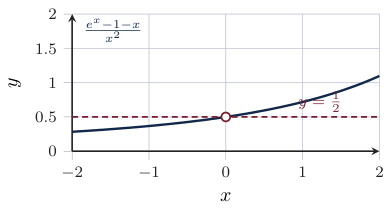
(a) Find \displaystyle\lim_{x\to0}\frac{e^x-1-x}{x^2} by l'Hôpital's rule and by using the Maclaurin series of e^x.
[4]
(b) Find \displaystyle\lim_{x\to0}\frac{\ln(1+x)-x}{x^2}.
[3]
(c) Find \displaystyle\lim_{x\to0}\frac{1-\cos3x}{x^2}.
[3]
(d) Find \displaystyle\lim_{x\to0}\frac{e^{2x}-1}{\sin x}.
[3]
(e) Explain which method you found quicker for (c), and why.
[2]
Show solutionHide solution
(a) Numerator and denominator both tend to 0 (R1). By l'Hôpital: \dfrac{\mathrm{e}^x-1}{2x}, still \frac00 (M1), then \dfrac{\mathrm{e}^x}{2}\to\dfrac12 (A1). By series: \mathrm{e}^x-1-x=\dfrac{x^2}2+\dfrac{x^3}6+\dots, so the ratio tends to \dfrac12 (A1).
(b) \ln(1+x)=x-\dfrac{x^2}2+\dfrac{x^3}3-\dots (M1), so \ln(1+x)-x=-\dfrac{x^2}2+\dfrac{x^3}3-\dots (A1) and the limit is -\dfrac12 (A1).
(c) \cos3x=1-\dfrac{9x^2}2+\dfrac{81x^4}{24}-\dots (M1), so 1-\cos3x=\dfrac{9x^2}2-\dots (A1) and the limit is \dfrac92 (A1).
(d) \mathrm{e}^{2x}-1=2x+2x^2+\dots and \sin x=x-\dots (M1 A1); dividing top and bottom by x gives \dfrac{2+2x+\dots}{1-\dots}\to2 (A1).
(e) The series needs one substitution, x\to3x, and one division (R1). l'Hôpital needs two rounds and the chain rule each time, with the form \frac00 checked twice (R1).

Final answer

Four limits two ways. (a) \frac12. (b) -\frac12. (c) \frac92. (d) 2. (e) the series is quicker.
Investigation 2

[16 marks]
This question asks you to build Maclaurin series from known series and to use one of them to estimate a logarithm.
Original Photon diagram
(a) By multiplying the Maclaurin series of e^x and \sin x, find the series of e^x\sin x as far as the x^3 term.
[3]
(b) Hence find \displaystyle\lim_{x\to0}\frac{e^x\sin x-x}{x^2}.
[2]
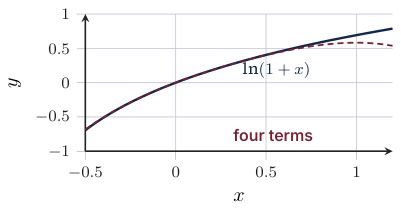
(c) Integrate the series \dfrac1{1+x}=1-x+x^2-x^3+\dots term by term to show that \ln(1+x)=x-\dfrac{x^2}2+\dfrac{x^3}3-\dfrac{x^4}4+\dots
[3]
(d) Use four terms of this series to estimate \ln1.2, giving your answer to four decimal places.
[3]
(e) Find an upper bound for the error in (d), giving a reason.
[2]
(f) Find \displaystyle\lim_{x\to0}\frac{x-\ln(1+x)}{x\sin x}.
[3]
Show solutionHide solution
(a) \left(1+x+\dfrac{x^2}2+\dfrac{x^3}6\right)\left(x-\dfrac{x^3}6\right) (M1); the x^2 term is x\cdot x=x^2 (A1) and the x^3 term is \dfrac{x^3}2-\dfrac{x^3}6=\dfrac{x^3}3, so x+x^2+\dfrac{x^3}3 (A1).
(b) \dfrac{\mathrm{e}^x\sin x-x}{x^2}=1+\dfrac x3+\dots (M1), so the limit is 1 (A1).
(c) \ln(1+x)=\displaystyle\int\dfrac1{1+x}\,\mathrm dx (M1) =x-\dfrac{x^2}2+\dfrac{x^3}3-\dfrac{x^4}4+C (A1), and C=0 because \ln1=0 (A1).
(d) x=0.2 (M1): 0.2-0.02+\dfrac{0.008}3-\dfrac{0.0016}4 (A1) =0.182267, so 0.1823 (A1).
(e) The series alternates with decreasing terms (R1), so the error is less than the first omitted term, \dfrac{0.2^5}5=0.000064 (A1).
(f) x-\ln(1+x)=\dfrac{x^2}2-\dfrac{x^3}3+\dots and x\sin x=x^2-\dots (M1 A1); dividing by x^2, the limit is \dfrac12 (A1).

Final answer

Building a series from another. (a) x+x^2+\frac{x^3}3. (b) 1. (d) 0.1823. (e) 0.000064. (f) \frac12.

Investigation 3

[22 marks]
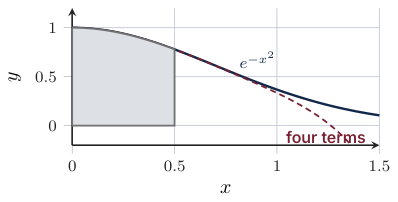
This question asks you to estimate an integral whose integrand has no elementary antiderivative.
Original Photon diagram
Let I=\displaystyle\int_0^{0.5}e^{-x^2}\,\mathrm dx.
(a) Write down the first four non-zero terms of the Maclaurin series of e^{-x^2}.
[2]
(b) Hence show that I\approx0.5-\dfrac{0.5^3}3+\dfrac{0.5^5}{10}-\dfrac{0.5^7}{42}, and evaluate this to six decimal places.
[4]
(c) Find an upper bound for the error in (b), giving a reason.
[3]
(d) Use your GDC to find I, and compare with (b) and (c).
[2]
(e) Find the least number of non-zero terms needed to estimate \displaystyle\int_0^1e^{-x^2}\,\mathrm dx with an error below 10^{-4}.
[5]
(f) Explain why the method becomes less efficient for \displaystyle\int_0^2e^{-x^2}\,\mathrm dx.
[2]
(g) Write \mathrm P(0<Z<0.5) for Z\sim\mathrm N(0,1) as an integral and use the series method to estimate it with three non-zero terms.
[4]
Show solutionHide solution
(a) Substitute -x^2 into the series of \mathrm{e}^x (M1): 1-x^2+\dfrac{x^4}2-\dfrac{x^6}6 (A1).
(b) Integrate term by term (M1): \left[x-\dfrac{x^3}3+\dfrac{x^5}{10}-\dfrac{x^7}{42}\right]_0^{0.5} (A1 A1) =0.5-\dfrac{0.5^3}3+\dfrac{0.5^5}{10}-\dfrac{0.5^7}{42}, which is 0.461272 (A1).
(c) The series alternates and its terms decrease (R1), so the error is less than the first omitted term (M1), \dfrac{0.5^9}{9\times24}=9.04\times10^{-6} (A1).
(d) GDC: I=0.461281 (A1). The difference from (b) is 9.0\times10^{-6}, inside the bound of (c) (A1).
(e) \displaystyle\int_0^1\mathrm{e}^{-x^2}\,\mathrm dx=\sum(-1)^k\dfrac{1}{(2k+1)k!} (M1 A1). The terms alternate and decrease, so the error is below the first omitted term (R1). \dfrac1{(2k+1)k!} is 1.07\times10^{-4} at k=6 (not below 10^{-4}) and 1.32\times10^{-5} at k=7 (M1 A1), so the terms k=0,\dots,6 are needed: 7 non-zero terms.
(f) At x=2 the terms \dfrac{2^{2k+1}}{(2k+1)k!} grow before they shrink (R1), so many terms are needed and large terms cancel (R1).
(g) \mathrm P(0<Z<0.5)=\dfrac1{\sqrt{2\pi}}\displaystyle\int_0^{0.5}\mathrm{e}^{-z^2/2}\,\mathrm dz (M1 A1). Using \mathrm{e}^{-z^2/2}=1-\dfrac{z^2}2+\dfrac{z^4}8 (M1) gives \dfrac1{\sqrt{2\pi}}\left(0.5-\dfrac{0.5^3}6+\dfrac{0.5^5}{40}\right)=0.191472 (A1).

Final answer

An integral with no antiderivative. (b) 0.461272. (c) 9.04\times10^{-6}. (d) 0.461281. (e) 7 terms. (f) terms grow before they shrink. (g) 0.191472 (GDC 0.191462).

Investigation 4

[22 marks]
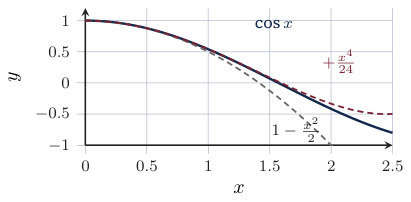
This question asks you to test the approximation \cos x\approx1-\dfrac{x^2}2 and to use a better one to improve a second function.
Original Photon diagram
(a) Show that \displaystyle\lim_{x\to0}\frac{\cos x-1+\frac{x^2}2}{x^4}=\frac1{24}.
[3]
(b) Find the percentage error in the approximation \cos x\approx1-\dfrac{x^2}2 when x=0.5.
[2]
(c) Find the largest value of x>0 for which the absolute error of the approximation in (b) is below 0.001.
[3]
(d) Use the series \cos x=1-\dfrac{x^2}2+\dfrac{x^4}{24}-\dots to show that \sec x=1+\dfrac{x^2}2+\dfrac{5x^4}{24}+\dots
[5]
(e) Hence find \displaystyle\lim_{x\to0}\frac{\sec x-1-\frac{x^2}2}{x^4}.
[2]
A road builder measures the sag s of a circular arc of radius R metres, where the arc subtends an angle 2\varphi at the centre. Then s=R(1-\cos\varphi).
(f) For R=200 and \varphi=0.1, find the error, in millimetres, when s is estimated by \dfrac{R\varphi^2}{2}.
[3]
(g) Find the largest \varphi for which the estimate \dfrac{R\varphi^2}2 is within 1 millimetre of s when R=200. Give your answer in degrees.
[4]
Show solutionHide solution
(a) \cos x-1+\dfrac{x^2}2=\dfrac{x^4}{24}-\dfrac{x^6}{720}+\dots (M1 A1); dividing by x^4 the limit is \dfrac1{24} (A1).
(b) 1-\dfrac{0.5^2}2=0.875 and \cos0.5=0.877583 (M1); percentage error \dfrac{0.877583-0.875}{0.877583}\times100=0.294\% (A1).
(c) The error is \cos x-1+\dfrac{x^2}2 (M1); setting it equal to 0.001 (A1) and solving on the GDC gives x=0.394 (A1).
(d) \sec x=\dfrac1{1-u} with u=\dfrac{x^2}2-\dfrac{x^4}{24} (M1). \dfrac1{1-u}=1+u+u^2+\dots (M1) =1+\dfrac{x^2}2-\dfrac{x^4}{24}+\dfrac{x^4}4 (A1 A1) =1+\dfrac{x^2}2+\dfrac{5x^4}{24} (A1).
(e) The numerator is \dfrac{5x^4}{24}+\dots (M1), so the limit is \dfrac5{24} (A1).
(f) s=200(1-\cos0.1)=0.999167 (A1); estimate \dfrac{200\times0.01}2=1 (A1); error 0.000833 m, which is 0.833 mm (A1).
(g) Error =\dfrac{R\varphi^2}2-R(1-\cos\varphi)=0.001 (M1) with R=200 (A1); solving, \varphi=0.1047 rad (A1), which is 6.00^\circ (A1).

Final answer

How good is the parabola. (b) 0.294%. (c) 0.394. (d) \sec x=1+\frac{x^2}2+\frac{5x^4}{24}. (e) \frac5{24}. (f) 0.833 mm. (g) 6.00^\circ.

Investigation 5

[21 marks]
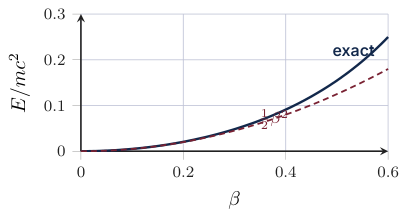
This question asks you to use a binomial series to compare the classical and the exact expressions for kinetic energy.
Original Photon diagram
A particle of mass m moves at speed v, and \beta=\dfrac vc where c is the speed of light. Its exact kinetic energy is E=mc^2\left(\dfrac1{\sqrt{1-\beta^2}}-1\right) and the classical estimate is E_0=\tfrac12mv^2.
(a) Find the Maclaurin series of (1-\beta^2)^{-1/2} as far as the \beta^4 term.
[3]
(b) Hence show that E\approx\tfrac12mv^2+\dfrac{3mv^4}{8c^2}.
[2]
(c) For v=0.1c, find the percentage by which E_0 underestimates E.
[3]
(d) For v=0.3c, find the percentage error in the two-term estimate of (b).
[3]
(e) Find the greatest value of \beta for which E_0 is at least 99% of E.
[4]
(f) Every coefficient of the series in (a) is positive. State what this tells you about the sign of the error in (d), and give a reason.
[3]
(g) Find \displaystyle\lim_{v\to0}\frac{E-\frac12mv^2}{mv^4/c^2}.
[3]
Show solutionHide solution
(a) (1+y)^p with y=-\beta^2, p=-\tfrac12 (M1): 1+\dfrac{\beta^2}2 (A1) +\dfrac{(-\frac12)(-\frac32)}{2}\beta^4=\dfrac{3\beta^4}8 (A1).
(b) E\approx mc^2\left(\dfrac{\beta^2}2+\dfrac{3\beta^4}8\right) (M1) and \beta^2c^2=v^2, so E\approx\dfrac12mv^2+\dfrac{3mv^4}{8c^2} (A1).
(c) \beta=0.1: E=mc^2(0.005038) and E_0=mc^2(0.005) (M1 A1); underestimate \dfrac{0.005038-0.005}{0.005038}=0.751\% (A1).
(d) \beta=0.3: exact 0.048285 and estimate 0.045+\dfrac{3(0.0081)}{8}=0.048038 (M1 A1); error 0.512% (A1).
(e) E_0\ge0.99E means \dfrac{\beta^2/2}{1/\sqrt{1-\beta^2}-1}\ge0.99 (M1 A1); solving the equality on the GDC gives \beta=0.115 (A1); the ratio decreases as \beta grows, so this is the greatest value (R1).
(f) The omitted terms are all positive (R1), so the estimate is smaller than the exact value (A1): it underestimates, as the figures 0.048038<0.048285 show (R1).
(g) \dfrac{E-\frac12mv^2}{mv^4/c^2}=\dfrac{mc^2\left(\frac{3\beta^4}8+\frac{5\beta^6}{16}+\dots\right)}{mc^2\beta^4} (M1 A1); the limit is \dfrac38 (A1).

Final answer

Kinetic energy at speed. (a) 1+\frac{\beta^2}2+\frac{3\beta^4}8. (c) 0.751%. (d) 0.512%. (e) \beta=0.115. (f) underestimates, omitted terms positive. (g) \frac38.

Investigation 6

[24 marks]
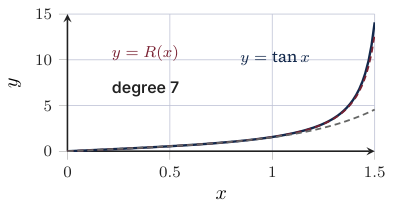
This question asks you to compare a rational approximation to \tan x with the Maclaurin polynomial.
Original Photon diagram
For x>0, let R(x)=\dfrac{x(15-x^2)}{15-6x^2}. You may use \tan x=x+\dfrac{x^3}3+\dfrac{2x^5}{15}+\dfrac{17x^7}{315}+\dots
(a) Use the binomial series for \left(1-\dfrac{2x^2}5\right)^{-1} to show that R(x) agrees with \tan x up to and including the x^5 term.
[5]
(b) Find the coefficient of x^7 in the series of R(x), and the difference between this coefficient and that of \tan x.
[3]
(c) Find the percentage error when \tan0.5 is estimated by R(0.5).
[3]
(d) Find the value of x at which R has a vertical asymptote, and compare it with that of \tan x.
[3]
(e) Find the largest value of x for which \left|\tan x-R(x)\right|<0.001.
[4]
(f) Find \displaystyle\lim_{x\to0}\frac{\tan x-R(x)}{x^7}.
[3]
(g) At x=1.5 the Maclaurin polynomial of \tan x of degree 7 is far from \tan1.5, but R(1.5) is not. Evaluate all three, and explain the difference.
[3]
Show solutionHide solution
(a) R(x)=x\left(1-\dfrac{x^2}{15}\right)\left(1-\dfrac{2x^2}5\right)^{-1} (M1). \left(1-\dfrac{2x^2}5\right)^{-1}=1+\dfrac{2x^2}5+\dfrac{4x^4}{25}+\dfrac{8x^6}{125}+\dots (M1). Multiplying, the x^3 coefficient is \dfrac25-\dfrac1{15}=\dfrac13 (A1) and the x^5 coefficient is \dfrac4{25}-\dfrac2{75}=\dfrac2{15} (A1). Both match \tan x, as does the x term (A1).
(b) x^7 coefficient: \dfrac8{125}-\dfrac4{375}=\dfrac4{75} (M1 A1). Difference \dfrac{17}{315}-\dfrac4{75}=\dfrac1{1575} (A1).
(c) R(0.5)=0.546296 and \tan0.5=0.546302 (M1 A1); percentage error 0.00113% (A1).
(d) 15-6x^2=0 (M1), so x=\sqrt{2.5}=1.581 (A1). The asymptote of \tan x is at \dfrac\pi2=1.571, only 0.010 away (A1).
(e) \tan x-R(x)=0.001 (M1 A1); from a graph of the difference, the first crossing is at x=0.937 (A1) and the difference is below 0.001 before it (R1).
(f) \tan x-R(x)=\left(\dfrac{17}{315}-\dfrac4{75}\right)x^7+\dots (M1 A1); the limit is \dfrac1{1575} (A1).
(g) Degree-7 polynomial: 4.56; R(1.5)=12.75; \tan1.5=14.10 (A1 A1). A polynomial stays finite, so it cannot follow a function that blows up near \frac\pi2; R has an asymptote nearby (R1).

Final answer

A fraction that beats the series. (b) \frac4{75}, difference \frac1{1575}. (c) 0.00113%. (d) x=1.58 against 1.57. (e) 0.937. (f) \frac1{1575}. (g) 4.56, 12.75, 14.10.

Investigation 7

[26 marks]
This question asks you to investigate a rule for estimating the length of a circular arc from two chords.
Original Photon diagram
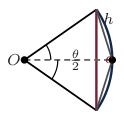
An arc of a circle of radius 1 subtends an angle \theta radians at the centre, 0<\theta<\pi. Let c be the length of the chord of the whole arc and h the length of the chord of half of the arc.
(a) Show that c=2\sin\dfrac\theta2 and h=2\sin\dfrac\theta4.
[3]
(b) Show that \displaystyle\lim_{\theta\to0}\frac{\theta-c}{\theta^3}=\frac1{24}.
[4]
(c) The estimate s=\dfrac{8h-c}3 is proposed for the arc length \theta. Use Maclaurin series to show that \theta-s\approx\dfrac{\theta^5}{7680} for small \theta.
[6]
(d) Find the percentage error in each of the estimates c and s when \theta=\dfrac\pi3.
[4]
(e) A cyclist rides along a circular bend of radius 80 m that turns through 60^\circ. Use the estimate s to find the length of the bend, and find the error in metres.
[3]
(f) Find the largest angle \theta for which s is within 1 mm of the true length of an arc on a circle of radius 80 m.
[4]
(g) Explain why s is much more accurate than c for small angles.
[2]
Show solutionHide solution
(a) The radii to the ends of the chord and the chord form an isosceles triangle with apex angle \theta; the perpendicular from the centre halves it (M1), so \tfrac c2=\sin\dfrac\theta2 (A1). The half-arc has angle \dfrac\theta2, so h=2\sin\dfrac\theta4 (A1).
(b) \theta-2\sin\dfrac\theta2=\theta-2\left(\dfrac\theta2-\dfrac{\theta^3}{48}+\dfrac{\theta^5}{3840}\right) (M1 A1) =\dfrac{\theta^3}{24}-\dfrac{\theta^5}{1920} (A1); dividing by \theta^3 and letting \theta\to0 gives \dfrac1{24} (A1).
(c) c=\theta-\dfrac{\theta^3}{24}+\dfrac{\theta^5}{1920} (M1 A1). 8h=16\sin\dfrac\theta4=4\theta-\dfrac{\theta^3}{24}+\dfrac{\theta^5}{7680} (M1 A1). Then 8h-c=3\theta-\dfrac{\theta^5}{2560} (A1), so s=\theta-\dfrac{\theta^5}{7680} and \theta-s\approx\dfrac{\theta^5}{7680} (A1).
(d) \theta=1.047198, c=2\sin\dfrac\pi6=1 (A1), so the error in c is \dfrac{0.047198}{1.047198}=4.51\% (A1). h=2\sin\dfrac\pi{12}=0.517638 and s=1.047\,043 (A1), so the error in s is 0.0155% (A1).
(e) s at \theta=\dfrac\pi3 times 80 gives 83.76 m (M1 A1); the true length is 80\times\dfrac\pi3=83.7758 m, so the error is 0.0130 m (A1).
(f) Error in metres =80(\theta-s) (M1) and \dfrac{80\theta^5}{7680}=0.001, so \theta^5=\dfrac{0.001\times7680}{80} (A1); \theta=0.626 rad (A1), confirmed on the GDC with the exact expression, which is 35.9^\circ (A1).
(g) In c the \theta^3 terms do not cancel; in s they do (R1), so the error of s is of order \theta^5 against \theta^3 for c: 0.0155% against 4.51% at \frac\pi3 (R1).

Final answer

Measuring an arc with two chords. (b) \theta-2\sin\frac\theta2=\frac{\theta^3}{24}-\dots. (c) 8h-c=3\theta-\frac{\theta^5}{2560}. (d) 4.51% and 0.0155%. (e) 83.76 m, error 0.0130 m. (f) \theta=0.626 rad (35.9^\circ). (g) the \theta^3 terms cancel.

Investigation 8

[27 marks]
This question asks you to build a series for a logarithm that converges quickly, and to measure how fast.
Original Photon diagram
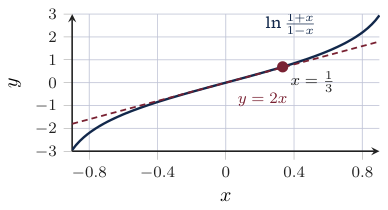
(a) Using the Maclaurin series of \ln(1+x) and of \ln(1-x), show that \ln\dfrac{1+x}{1-x}=2\left(x+\dfrac{x^3}3+\dfrac{x^5}5+\dots\right) for -1<x<1.
[3]
(b) Show that x=\dfrac13 gives \ln2=2\left(\dfrac13+\dfrac1{81}+\dfrac1{1215}+\dots\right).
[2]
(c) Use the first three terms to estimate \ln2 to five decimal places, and find the actual error.
[3]
(d) All terms after the third are positive and each is less than \dfrac19 of the one before. Show that the error in (c) is less than \dfrac98 of the fourth term, and evaluate this bound.
[4]
(e) Use the bound in (d) to find the least number of terms that guarantees an error below 10^{-5}.
[4]
(f) Use x=\dfrac12 and four terms to estimate \ln3, and find an upper bound for the error.
[3]
(g) Explain why the bound in (f) is larger than the bound in (e) for the same number of terms.
[2]
(h) The alternating series \ln2=1-\dfrac12+\dfrac13-\dots comes from x=1 in the series for \ln(1+x). Find the least number of terms that guarantees an error below 10^{-5}.
[3]
(i) Show that for every y>0, the value x=\dfrac{y-1}{y+1} satisfies -1<x<1 and \ln\dfrac{1+x}{1-x}=\ln y.
[3]
Show solutionHide solution
(a) \ln(1+x)=x-\dfrac{x^2}2+\dfrac{x^3}3-\dots and \ln(1-x)=-x-\dfrac{x^2}2-\dfrac{x^3}3-\dots (M1 A1). Subtracting, the even powers cancel and the odd powers double: 2\left(x+\dfrac{x^3}3+\dfrac{x^5}5+\dots\right) (A1).
(b) \dfrac{1+\frac13}{1-\frac13}=\dfrac{4/3}{2/3}=2 (M1). Then x^3=\dfrac1{27} gives \dfrac1{81} and x^5=\dfrac1{243} gives \dfrac1{1215} (A1).
(c) 2\left(\dfrac13+\dfrac1{81}+\dfrac1{1215}\right) (M1) =0.69300 (A1). \ln2=0.693147, so the error is 0.000143 (A1).
(d) The fourth term is t_4=\dfrac{2}{7\times3^7}=0.000131 (A1). The remaining terms are t_5,t_6,\dots with t_{k+1}<\dfrac{t_k}9 (M1), so the error is less than t_4\left(1+\dfrac19+\dfrac1{81}+\dots\right) (M1) =t_4\times\dfrac98=0.000147 (A1).
(e) After n terms the bound is \dfrac98t_{n+1}: 1.27\times10^{-5} after 4 terms (not below 10^{-5}) (M1 A1) and 1.15\times10^{-6} after 5 terms (A1), so 5 terms are needed (A1).
(f) 2\left(\dfrac12+\dfrac1{24}+\dfrac1{160}+\dfrac1{896}\right)=1.09807 (M1 A1). The ratio is now \dfrac14, so the error is less than \dfrac43t_5=0.000579 (A1).
(g) The terms shrink by a factor x^2 each time: \dfrac14 for x=\dfrac12 against \dfrac19 for x=\dfrac13 (R1), so the omitted terms are larger and decrease more slowly (R1).
(h) The series alternates with decreasing terms, so the error is less than the first omitted term \dfrac1{n+1} (M1). \dfrac1{n+1}<10^{-5} needs n+1>10^5 (A1), so n=10^5 terms (A1).
(i) y>0 gives y-1<y+1 and y-1>-(y+1) because 2y>0 (M1 R1). \dfrac{1+x}{1-x}=\dfrac{(y+1)+(y-1)}{(y+1)-(y-1)}=\dfrac{2y}2=y (A1).

Final answer

Logarithms from an odd series. (b) x=\frac13. (c) 0.69300, error 0.000143. (d) \frac98t_4=0.000147. (e) 5 terms. (f) 1.09807, error below 0.000579. (g) ratio \frac14 against \frac19. (h) 10^5 terms. (i) proof.

Going further

Beyond the syllabus: the worked examples and investigations of the chapter's Going further pages.

Investigation

[24 marks]
Worked investigation 1: Roots from a series.
This question asks you to approximate square roots and cube roots with a series and to judge the accuracy. Throughout, f(x)=(1+x)^{1/2}, defined for x>-1.
(a) Find the Maclaurin series of f(x) as far as the x^3 term.
[4]
(b) By writing \sqrt5=2\sqrt{1+\frac14}, use your series to estimate \sqrt5, giving your answer to six decimal places.
[3]
(c) The next term of the series is -\dfrac{5x^4}{128}. Use it to estimate the error in (b), and compare with the actual error.
[3]
(d) By applying l'Hôpital's rule, evaluate \displaystyle\lim_{x\to0}\frac{\sqrt{1+x}-1-\frac x2}{x^2}, and explain how your answer relates to the series in (a).
[3]
(e) Explain why the series in (a) is a poor way to estimate \sqrt2.
[2]
(f) Show that the first three terms of the Maclaurin series of (1+x)^p are 1+px+\dfrac{p(p-1)}{2}x^2.
[3]
(g) Use four terms of the series for (1+x)^{1/3} to estimate \sqrt[3]{9}.
[3]
(h) Prove that \sqrt{1+x}\le1+\dfrac x2 for all x\ge-1.
[3]
Show solutionHide solution
(a) f(0)=1, and f'(x)=\tfrac12(1+x)^{-1/2}, so f'(0)=\tfrac12 (M1 A1); f''(x)=-\tfrac14(1+x)^{-3/2} and f'''(x)=\tfrac38(1+x)^{-5/2}, so f''(0)=-\tfrac14, f'''(0)=\tfrac38 (A1); f(x)=1+\dfrac x2-\dfrac{x^2}{8}+\dfrac{x^3}{16}+\dots (A1).
(b) \sqrt5=2\sqrt{1+x} with x=\dfrac14 (M1); \sqrt5\approx2\left(1+\dfrac18-\dfrac1{128}+\dfrac1{1024}\right) (A1); =2.236328 to six decimal places (A1).
(c) Next term at x=\frac14: 2\times\dfrac{5}{128\times256}=0.000305 (M1 A1); Actual error 2.236328-\sqrt5=0.000260, so the estimate is the right size and slightly too large (A1).
(d) Both numerator and denominator tend to 0: form \frac00 (R1); \displaystyle\lim=\lim_{x\to0}\frac{\frac12(1+x)^{-1/2}-\frac12}{2x}, again \frac00; again: \lim\dfrac{-\frac14(1+x)^{-3/2}}{2}=-\dfrac18 (M1 A1); This is the coefficient of x^2 in (a) (AG).
(e) \sqrt2=\sqrt{1+1} needs x=1, the end of the interval -1<x<1 where the series is valid (R1); the terms \frac12,\ \frac18,\ \frac1{16},\ \frac5{128},\dots shrink slowly, so many terms are needed (R1).
(f) g(x)=(1+x)^p: g'(x)=p(1+x)^{p-1} and g''(x)=p(p-1)(1+x)^{p-2} (M1 A1); g(0)=1, g'(0)=p, g''(0)=p(p-1) (A1); 1+px+\dfrac{p(p-1)}{2!}x^2 (AG).
(g) 9^{1/3}=2\left(1+\tfrac18\right)^{1/3} (M1); (1+x)^{1/3}=1+\dfrac x3-\dfrac{x^2}9+\dfrac{5x^3}{81} (A1); \sqrt[3]9\approx2\left(1+\dfrac1{24}-\dfrac1{576}+\dfrac5{41472}\right)=2.08010 (A1).
(h) Both sides are non-negative for x\ge-1, so the inequality is equivalent to 1+x\le\left(1+\dfrac x2\right)^2 (M1 R1); \left(1+\dfrac x2\right)^2-(1+x)=\dfrac{x^2}4\ge0, true for every x (A1).

Final answer

(a) 1+\frac x2-\frac{x^2}8+\frac{x^3}{16}; (b) 2.236328; (c) estimate 0.000305, actual 0.000260; (d) -\frac18; (e) x=1 is at the edge of validity; (f) proof; (g) 2.08010; (h) proof.

Investigation

[26 marks]
Worked investigation 2: How small is a small angle.
This question asks you to test the approximations used for small angles and to improve them.
(a) Applying l'Hôpital's rule as many times as needed, show that \displaystyle\lim_{x\to0}\frac{x-\sin x}{x^3}=\frac16.
[4]
(b) Find the percentage error when \sin x is approximated by x for an angle of 10^\circ.
[2]
(c) Find the largest angle, in degrees, for which the approximation \sin x\approx x has a percentage error below 1\%.
[3]
(d) Using the Maclaurin series for \sin x and \cos x, show that \tan x=x+\dfrac{x^3}3+\dfrac{2x^5}{15}+\dots
[5]
(e) Hence find \displaystyle\lim_{x\to0}\frac{\tan x-x}{x-\sin x}.
[3]
(f) A clockmaker uses the approximation T\approx T_0\left(1+\dfrac{\theta_0^2}{16}\right) for the period of a pendulum swinging through a maximum angle \theta_0 radians, where T_0 is the period for very small swings. Find the percentage increase in the period when \theta_0=20^\circ.
[2]
(g) Show that, for small x, \dfrac{3\sin x}{2+\cos x}\approx x-\dfrac{x^5}{180}, and explain why this is a better approximation to x than \sin x is.
[5]
(h) Use (g) to estimate an angle x for which \dfrac{3\sin x}{2+\cos x}=0.5, and compare with the exact solution found on your GDC.
[2]
Show solutionHide solution
(a) \dfrac{x-\sin x}{x^3}\to\dfrac00 as x\to0 (M1); \lim\tfrac{1-\cos x}{3x^2}, still \frac00 (A1); \lim\tfrac{\sin x}{6x}, still \frac00 (A1); \lim\tfrac{\cos x}{6}=\tfrac16 (A1); \lim\tfrac{x-\sin x}{x^3}=\tfrac16 (AG).
(b) x=10^\circ=0.174533 rad and \sin x=0.173648 (M1); error =\tfrac{0.174533-0.173648}{0.173648}\times100\% =0.510\% (A1).
(c) Need x-\sin x<0.01\sin x, that is x<1.01\sin x (M1); Solving x=1.01\sin x: x=0.244 rad (A1); =14.0^\circ (A1).
(d) \tan x=\tfrac{x-\frac{x^3}6+\frac{x^5}{120}}{1-\frac{x^2}2+\frac{x^4}{24}} (M1); \tfrac1{1-u}\approx1+u+u^2 with u=\tfrac{x^2}2-\tfrac{x^4}{24}: 1+\tfrac{x^2}2+\tfrac{5x^4}{24} (M1 A1); Multiplying: x+x^3\left(\tfrac12-\tfrac16\right)=x+\tfrac{x^3}3 (A1); x^5 terms: \tfrac5{24}-\tfrac1{12}+\tfrac1{120} (A1); =\tfrac{2x^5}{15} (AG).
(e) \tan x-x=\tfrac{x^3}3+\tfrac{2x^5}{15}+\dots and x-\sin x=\tfrac{x^3}6-\tfrac{x^5}{120}+\dots (A1 A1); Divide by x^3, let x\to0: \left.\tfrac13\right/\tfrac16=2 (A1).
(f) \theta_0=20^\circ=0.349066 rad (M1); increase =100\times0.349066^2\div16=0.762\% (A1).
(g) 2+\cos x=3-\tfrac{x^2}2+\tfrac{x^4}{24}=3\left(1-\tfrac{x^2}6+\tfrac{x^4}{72}\right) (M1 A1); \tfrac1{1-v}\approx1+v+v^2 with v=\tfrac{x^2}6-\tfrac{x^4}{72}: 1+\tfrac{x^2}6+\tfrac{x^4}{72} (M1); \left(x-\tfrac{x^3}6+\tfrac{x^5}{120}\right)\left(1+\tfrac{x^2}6+\tfrac{x^4}{72}\right)=x+x^5\left(\tfrac1{72}-\tfrac1{36}+\tfrac1{120}\right) (A1); =x-\tfrac{x^5}{180} (AG); The error of \sin x\approx x is of order x^3; here it is of order x^5, much smaller for small x (R1).
(h) x-\dfrac{x^5}{180}=0.5 gives x\approx0.5+\dfrac{0.5^5}{180}=0.500174 (M1); GDC gives 0.500179; the difference is the next term, of order x^7 (A1).

Final answer

(a) proof; (b) 0.510\%; (c) 14.0^\circ; (d) proof; (e) 2; (f) 0.762\%; (g) proof; (h) 0.500174, GDC 0.500179.

From the book

Photon Guidebook: Mathematics HL Paper 3 for the IB Diploma

Chapter 5 teaches limits, maclaurin series and approximation: how the IB builds this kind of Paper 3 question, the techniques, marked worked investigations, and practice investigations like these.

About the book