Free worked solutions · 2026 Edition

IB Maths HL Paper 3 Chapter 1: How Paper 3 works worked solutions

Worked solutions to the practice questions in Chapter 1 of Photon Guidebook: Mathematics HL Paper 3 for the IB Diploma (2026 Edition). Each solution shows every step with the mark it earns, the way an IB mark scheme does.

  • Chapter 1 of 18
  • 15 practice questions
  • 2 Going further
  • Free, no sign-up

Drills

Short drills from the chapter, with full worked solutions.

Investigation 1

[6 marks]
Name the stage. A question about a sequence u_n has the six parts below. Each part belongs to one arc stage: ORIENT, STRUCTURE, EXPLORE, DEDUCE, GENERALISE or INTERPRET. Match each part to a stage, using each once.
(a) Write down the first three terms.
[1]
(b) Show that u_{n+1}=3u_n-2.
[1]
(c) Use your GDC to tabulate u_n and suggest a formula for u_n.
[1]
(d) Prove by induction that your formula is correct.
[1]
(e) Find a formula for u_n when the first term is replaced by a.
[1]
(f) Comment on whether such growth is realistic for a real population.
[1]
Show solutionHide solution
(a) ORIENT. (b) STRUCTURE. (c) EXPLORE. (d) DEDUCE. (e) GENERALISE. (f) INTERPRET. One mark for each correct match.

Final answer

  • (a) Orient
  • (b) Structure
  • (c) Explore
  • (d) Deduce
  • (e) Generalise
  • (f) Interpret.

Investigation 2

[3 marks]
Spend the hour. Paper 3 is 55 marks in 60 minutes. Question 1 is worth 29 marks.
(a) Find how many minutes Question 1 deserves, to the nearest minute.
[1]
(b) Find the number of marks in Question 2, and the minutes it deserves, to the nearest minute.
[2]
Show solutionHide solution
(a) \frac{60}{55}\times29=31.6\approx32 minutes (A1). (b) 55-29=26 marks (A1) and \frac{60}{55}\times26=28.4\approx28 minutes (A1).

Final answer

(a) 32 minutes. (b) 26 marks, 28 minutes.

Investigation 3

[3 marks]
Exact means exact. The area under the curve y=\dfrac2x from x=1 to x=k, where k>1, is 5.
(a) Find the exact value of k.
[2]
(b) A student writes k=12.2. State which mark is lost and why.
[1]
Show solutionHide solution
(a) \int_1^k\frac2x\,\mathrm{d}x=2\ln k=5 (M1), so k=\mathrm{e}^{5/2} (A1). (b) The A1 is lost: 12.2 is a rounding of \mathrm{e}^{5/2}=12.18, and the question asked for an exact value.

Final answer

(a) k=\mathrm{e}^{5/2}. (b) The A1: a decimal where an exact value is asked.

Investigation 4

[3 marks]
Hence means hence. Part (c) shows that \dfrac{\mathrm{d}}{\mathrm{d}x}\left(x\ln x-x\right)=\ln x. Part (d) reads: “Hence find \displaystyle\int_1^{e}\ln x\,\mathrm{d}x.”
(i) Write down the first line of the answer that uses (c).
[1]
(ii) Find the value of the integral.
[1]
(iii) A student ignores (c) and integrates by parts, reaching the correct value. Explain why this may score no marks.
[1]
Show solutionHide solution
(i) By (c), \int_1^{\mathrm{e}}\ln x\,\mathrm{d}x=\left[x\ln x-x\right]_1^{\mathrm{e}} (M1). (ii) (\mathrm{e}-\mathrm{e})-(0-1)=1 (A1). (iii) “Hence” instructs the candidate to use the previous result; a different method does not follow the instruction, so the marks tied to it may not be awarded (R1).

Final answer

(i) \left[x\ln x-x\right]_1^{\mathrm{e}}. (ii) 1. (iii) “Hence” requires the use of (c).

Investigation 5

[3 marks]
Write the decision. A test of the claim that a new bus route is shorter than the old one, at the 1% significance level, gives a p-value of 0.034. A student writes: “p=0.034, so we reject H_0 and the new route is proved shorter.”
(a) Write down the comparison that decides the test.
[1]
(b) Write a correct conclusion, in context.
[2]
Show solutionHide solution
(a) 0.034>0.01 (A1). (b) Do not reject H_0 (R1): there is not enough evidence at the 1% level that the new route is shorter (R1). A test never proves a claim.

Final answer

(a) 0.034>0.01. (b) Do not reject H_0: not enough evidence at the 1% level that the new route is shorter.

Investigation 6

[3 marks]
Mark the induction. A sequence has u_1=2 and u_{n+1}=3u_n+2. A student proves that u_n=3^n-1 for all n\in\mathbb{Z}^+ like this:
“Assume true for n=k: u_k=3^k-1. Then u_{k+1}=3(3^k-1)+2=3^{k+1}-1. So it is true for all n.”
The proof is marked out of 4: A1 for the base case, M1 for the assumption, A1 for the algebra, R1 for the conclusion.
(a) State the marks the student earns.
[1]
(b) Write the two pieces that are missing.
[2]
Show solutionHide solution
(a) M1 and A1: 2 of the 4 marks (A1). (b) The base case, u_1=3^1-1=2 (A1), and the conclusion: true for n=1, and true for n=k implies true for n=k+1, so true for all n\in\mathbb{Z}^+ (A1).

Final answer

(a) 2 of 4 (M1 and A1). (b) The base case u_1=2; the conclusion by induction.

Investigations

The practice investigations of the chapter, each with its full worked solution and mark scheme.

Investigation 7

[9 marks]
Strings across a lawn
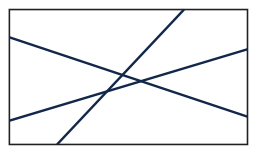
A gardener stretches straight strings from edge to edge across a rectangular lawn to mark out beds. No two strings are parallel, no three strings meet at one point, and every pair of strings crosses on the lawn. Let R_n be the number of regions into which n strings divide the lawn. The diagram shows n=3.
Original Photon diagram
(a) Write down R_1, R_2 and R_3.
[2]
(b) Explain why the (n+1)th string adds exactly n+1 regions.
[2]
(c) Hence show that R_n=\dfrac{n^2+n+2}{2}.
[3]
(d) Find the least number of strings that divides the lawn into more than 500 regions.
[2]
Show solutionHide solution
(a) R_1=2, R_2=4, R_3=7 (M1 for any correct count from the diagram, A1 for all three).
(b) The new string crosses each of the n existing strings once, so n crossing points cut it into n+1 pieces (R1). Each piece splits one old region into two, so n+1 regions are added (R1).
(c) Part (b) gives R_{n}=R_{n-1}+n, with R_0=1 (M1). Adding, R_n=1+(1+2+\dots+n) (R1), and 1+2+\dots+n=\frac{n(n+1)}{2} (A1), so R_n=1+\frac{n^2+n}{2}=\frac{n^2+n+2}{2} (AG).
(d) Solve \frac{n^2+n+2}{2}>500 (M1): R_{31}=497 and R_{32}=529, so the least number of strings is 32 (A1).

Final answer

(a) 2,4,7. (d) 32 strings.

Investigation 8

[11 marks]
A family with a moving peak
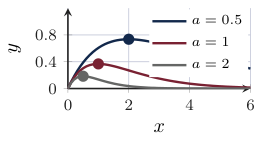
For each positive constant a, the curve C_a has equation y=xe^{-ax} for x\ge0. The diagram shows C_{0.5}, C_1 and C_2, with the highest point of each marked.
Original Photon diagram
(a) Show that \dfrac{\mathrm{d}y}{\mathrm{d}x}=(1-ax)e^{-ax}.
[2]
(b) Find, in terms of a, the coordinates of the highest point of C_a, and justify that it is a maximum.
[3]
(c) Show that the highest points of the curves C_a all lie on one line, and write down the equation of that line.
[2]
(d) Show that C_a has exactly one point of inflexion, and find its coordinates in terms of a.
[3]
(e) Show that the points of inflexion also lie on a straight line through the origin. State its gradient.
[1]
Show solutionHide solution
(a) Product rule: \frac{\mathrm{d}y}{\mathrm{d}x}=\mathrm{e}^{-ax}+x(-a)\mathrm{e}^{-ax} (M1) =(1-ax)\mathrm{e}^{-ax} (AG).
(b) \mathrm{e}^{-ax}>0, so \frac{\mathrm{d}y}{\mathrm{d}x}=0 only at x=\frac1a (M1), where y=\frac1a\mathrm{e}^{-1}, so the point is \left(\frac1a,\frac{1}{a\mathrm{e}}\right) (A1). The gradient is positive for x<\frac1a and negative for x>\frac1a, so it is a maximum (R1).
(c) For the point in (b), y=\frac{1}{a\mathrm{e}}=\frac{x}{\mathrm{e}} because x=\frac1a (M1). So every highest point lies on the line y=\frac{x}{\mathrm{e}} (A1).
(d) \frac{\mathrm{d}^2y}{\mathrm{d}x^2}=-a\mathrm{e}^{-ax}-a(1-ax)\mathrm{e}^{-ax}=(a^2x-2a)\mathrm{e}^{-ax} (M1). This is zero only at x=\frac2a (A1), and it changes sign there (negative before, positive after), so there is exactly one point of inflexion, \left(\frac2a,\frac{2}{a\mathrm{e}^{2}}\right) (A1).
(e) At the point in (d), y=\frac{2}{a\mathrm{e}^2}=\frac{x}{\mathrm{e}^2} because x=\frac2a, so the points lie on y=\frac{x}{\mathrm{e}^{2}}, gradient \mathrm{e}^{-2}=0.135 (R1).

Final answer

(b) \left(\frac1a,\frac1{a\mathrm{e}}\right). (c) y=\frac{x}{\mathrm{e}}. (d) \left(\frac2a,\frac{2}{a\mathrm{e}^2}\right). (e) gradient \mathrm{e}^{-2}=0.135.

Investigation 9

[11 marks]
Roots on a circle
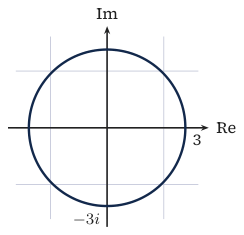
For a positive integer n, the solutions of z^n=3^n are plotted on an Argand diagram. The diagram shows the circle of radius 3 centred at the origin.
Original Photon diagram
(a) For n=3, solve z^3=27 in the form re^{i\theta} with -\pi<\theta\le\pi.
[2]
(b) The three solutions are the vertices of a triangle. Find the exact area of the triangle.
[3]
(c) For general n, the solutions are the vertices of a polygon with n sides and area A_n. Show that A_n=\dfrac{9n}{2}\sin\dfrac{2\pi}{n}.
[2]
(d) Find the least value of n for which A_n is within 1% of the area of the circle.
[3]
(e) State the limit of A_n as n\to\infty, with a reason.
[1]
Show solutionHide solution
(a) The solutions have modulus 3 and arguments 0,\pm\frac{2\pi}{3} (M1): z=3, z=3\mathrm{e}^{2\pi\mathrm{i}/3}, z=3\mathrm{e}^{-2\pi\mathrm{i}/3} (A1).
(b) The centre and two adjacent vertices form a triangle with two sides 3 and angle \frac{2\pi}{3} between them: area \frac12\times3\times3\times\sin\frac{2\pi}{3} (M1) =\frac{9\sqrt3}{4} (A1). The triangle is three of these, so its area is \frac{27\sqrt3}{4}\ (=11.7) (A1).
(c) The polygon is n congruent triangles meeting at the origin, each with two sides 3 and included angle \frac{2\pi}{n} (R1). So A_n=n\times\frac12\times3^2\sin\frac{2\pi}{n}=\frac{9n}{2}\sin\frac{2\pi}{n} (AG).
(d) The circle has area 9\pi. We need A_n\ge0.99\times9\pi (M1). Tabulating, A_{25}=9\pi\times0.98951 is below this and A_{26}=9\pi\times0.99030 is above it (M1 for a table or solve). The least value is n=26 (A1).
(e) For large n, \sin\frac{2\pi}{n}\approx\frac{2\pi}{n}, so A_n\to\frac{9n}{2}\times\frac{2\pi}{n}=9\pi, the area of the circle (R1).

Final answer

(a) 3, 3\mathrm{e}^{\pm2\pi\mathrm{i}/3}. (b) \frac{27\sqrt3}{4}. (d) n=26. (e) 9\pi.

Investigation 10

[11 marks]
Approaching e
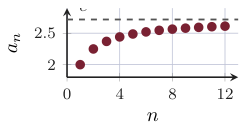
For each positive integer n, let a_n=\left(1+\dfrac1n\right)^n. The diagram shows a_n for n=1,\dots,12, with the line y=e dashed.
Original Photon diagram
(a) Write down a_1, a_2 and a_3.
[2]
(b) Use your GDC to find a_{1000}.
[1]
(c) Show that \ln a_n=n\ln\left(1+\dfrac1n\right). Use the Maclaurin series of \ln(1+x) up to the x^3 term to show that \ln a_n\approx1-\dfrac{1}{2n}+\dfrac{1}{3n^2}.
[3]
(d) Hence show that a_n\to e as n\to\infty.
[2]
(e) Use the approximation in (c) to estimate the least n for which a_n is within 0.1% of e. Check your value with your GDC.
[3]
Show solutionHide solution
(a) a_1=2, a_2=\frac94=2.25 (A1) and a_3=\frac{64}{27}=2.37 (A1).
(b) a_{1000}=2.72 (A1; stored value 2.71692).
(c) \ln a_n=\ln\left(1+\frac1n\right)^n=n\ln\left(1+\frac1n\right) (A1). The series is \ln(1+x)=x-\frac{x^2}{2}+\frac{x^3}{3}-\dots (M1). With x=\frac1n, \ln a_n\approx n\left(\frac1n-\frac{1}{2n^2}+\frac{1}{3n^3}\right) (M1) =1-\frac{1}{2n}+\frac{1}{3n^2} (AG).
(d) As n\to\infty, \frac{1}{2n}\to0 and \frac{1}{3n^2}\to0, so \ln a_n\to1 (R1). Hence a_n\to \mathrm{e}^1=\mathrm{e} (A1).
(e) We need \ln a_n\ge\ln0.999=-0.0010005 (M1) (since a_n/\mathrm{e}=\mathrm{e}^{\ln a_n-1}). Using \ln a_n-1\approx-\frac{1}{2n} gives n\ge499.75, so the estimate is n=500 (A1). On the GDC, a_{499}/\mathrm{e}=0.9989998<0.999 and a_{500}/\mathrm{e}=0.9990018>0.999, so the least n is 500 (A1).

Final answer

(a) 2, 2.25, 2.37. (b) 2.72. (e) n=500.

Investigation 11

[9 marks]
Which checkout?
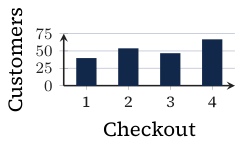
A supermarket has four self-service checkouts in a row, numbered 1 to 4. The manager, Jun, suspects that customers do not choose a checkout at random. One afternoon he records the checkout chosen by each of 200 customers.
\begin{array}{|l|cccc|}\hline \text{Checkout} & 1 & 2 & 3 & 4\\\hline \text{Customers} & 38 & 52 & 45 & 65\\\hline\end{array}
Original Photon diagram
(a) Write down suitable hypotheses for a \chi^2 goodness of fit test of Jun's suspicion.
[1]
(b) Show that, under the null hypothesis, the expected number of customers at each checkout is 50, and state the degrees of freedom of the test.
[2]
(c) Find the value of \chi^2 and the p-value.
[2]
(d) State the conclusion of the test at the 5% significance level, in context.
[2]
(e) Jun repeats the test at the 1% level. State whether his conclusion changes, with a reason.
[1]
(f) Checkout 4 is nearest the door. Suggest how this could explain the data.
[1]
Show solutionHide solution
(a) H_0: customers choose each checkout with equal probability, \frac14. H_1: they do not (A1).
(b) 200\times\frac14=50 (A1). There are 4 categories and no parameter is estimated, so \text{df}=4-1=3 (A1).
(c) \chi^2=\frac{(38-50)^2+(52-50)^2+(45-50)^2+(65-50)^2}{50}=\frac{398}{50}=7.96 (M1), p=0.0468 (A1).
(d) 0.0468<0.05 (A1), so reject H_0: there is evidence at the 5% level that customers do not choose the checkouts equally often (R1).
(e) 0.0468>0.01, so at the 1% level H_0 is not rejected: the conclusion changes (R1).
(f) Customers may prefer the checkout nearest the door, so a checkout's position, not chance, changes how often it is chosen (R1).

Final answer

(b) 50, \text{df}=3. (c) \chi^2=7.96, p=0.0468. (d) Reject H_0. (e) Do not reject H_0 at 1%.

Investigation 12

[9 marks]
Cabling five villages
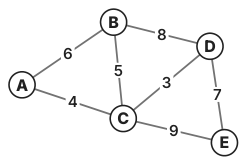
Five villages A, B, C, D and E can be joined by cables along the routes shown. The numbers are the lengths of the routes in kilometres.
Original Photon diagram
(a) Use Kruskal's algorithm to find a minimum spanning tree. List the routes in the order chosen and state the total length.
[3]
An engineer wants to inspect every village once and return to the start.
(b) Delete C and its routes. Find a minimum spanning tree of the remaining graph and hence find a value below which the shortest inspection route cannot fall.
[3]
(c) Find a route that visits every village once and returns to its start, and state the upper bound it gives.
[2]
(d) Give one reason why the shortest route may be longer than your lower bound.
[1]
Show solutionHide solution
(a) In order of length: CD (3), AC (4), BC (5), then AB (6) is rejected because it would form a cycle ABC, and DE (7) completes the tree (M1 for the order and the rejection, A1 for the four routes). Total length 3+4+5+7=19 km (A1).
(b) Without C the graph is the path A–B–D–E with lengths 6, 8, 7, so the minimum spanning tree has length 21 (M1). Add the two shortest routes at C, CD (3) and CA (4) (M1): the lower bound is 21+3+4=28 km (A1).
(c) For example A–B–D–E–C–A has length 6+8+7+9+4=34 km (A1), so the shortest route is at most 34 km (A1).
(d) The tree and the two routes at C do not form a single cycle through every village (E is joined to only one route), so 28 km may not be possible (R1).

Final answer

(a) CD, AC, BC, DE; 19 km. (b) 21; lower bound 28 km. (c) 34 km, for example ABDECA.

Investigation 13

[11 marks]
Sharing bikes
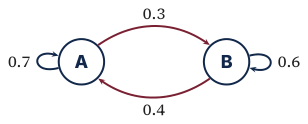
A city has two docking stations, A and B, and 120 bikes that are always at one of the two stations at the start of each day. During each day, 30% of the bikes at A are taken to B, and 40% of the bikes at B are taken to A. At the start of day 0 there are 80 bikes at A and 40 at B. The diagram shows the model.
Original Photon diagram
(a) Write down the transition matrix T, so that T\binom{a}{b} gives the numbers at A and B at the start of the next day.
[2]
(b) Find the number of bikes at each station at the start of day 1.
[2]
(c) Find the numbers of bikes at A and at B in the long run.
[3]
(d) The number of bikes at A at the start of day n is \dfrac{480}{7}+\dfrac{80}{7}(0.3)^n. Find the least n for which this is within one bike of its long-run value.
[3]
(e) State one assumption of the model that may not hold in practice.
[1]
Show solutionHide solution
(a) T=\begin{pmatrix}0.7&0.4\\0.3&0.6\end{pmatrix} (A1 for each column; each column sums to 1) (A1 A1).
(b) \begin{pmatrix}0.7&0.4\\0.3&0.6\end{pmatrix}\binom{80}{40}=\binom{72}{48} (M1 A1): 72 at A and 48 at B.
(c) In the long run T\binom ab=\binom ab, so 0.3a=0.4b (M1). With a+b=120 (M1), a=\frac{480}{7}=68.6 and b=\frac{360}{7}=51.4 (A1).
(d) The long-run value is \frac{480}{7}, so we need \frac{80}{7}(0.3)^n<1 (M1), that is 0.3^n<0.0875 (A1). n=2 gives \frac{80}{7}\times0.09=1.03>1 and n=3 gives 0.309<1, so n=3 (A1).
(e) For example, the percentages moved are the same every day, although demand changes with the day of the week (R1).

Final answer

(a) \begin{pmatrix}0.7&0.4\\0.3&0.6\end{pmatrix}. (b) 72 and 48. (c) 68.6 and 51.4. (d) n=3.

Investigation 14

[11 marks]
A wind turbine
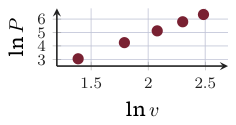
An engineer records the power P kW produced by a wind turbine at five steady wind speeds v m s^{-1}.
\begin{array}{|l|ccccc|}\hline v & 4 & 6 & 8 & 10 & 12\\\hline P & 21 & 70 & 168 & 331 & 569\\\hline\end{array}
She models the power by P=av^b, where a and b are constants. The diagram shows \ln P against \ln v.
Original Photon diagram
(a) Show that \ln P=\ln a+b\ln v.
[2]
(b) Using linear regression, find the equation of the regression line of \ln P on \ln v.
[2]
(c) Hence find the values of a and b, and estimate the power at 9\ \text{m s}^{-1}.
[3]
(d) Theory suggests that P is proportional to v^3. Comment on whether the data support this.
[1]
(e) Find the wind speed at which the model predicts a power of 800 kW.
[2]
(f) The generator cannot deliver more than 800 kW. Comment on the model at your answer to (e).
[1]
Show solutionHide solution
(a) Taking logarithms of P=av^b gives \ln P=\ln a+\ln v^b (M1) =\ln a+b\ln v (AG).
(b) Regression of \ln P on \ln v: \ln P=3.01\ln v-1.13 (A1 A1; stored values 3.00922 and −1.13291).
(c) b=3.01 (A1) and a=\mathrm{e}^{-1.13291}=0.322 (A1). The estimate is P=0.32209\times9^{3.00922}=240 kW (A1).
(d) b=3.01 is very close to 3, so the data support the cube law (R1).
(e) 800=0.32209\,v^{3.00922} gives v=\left(\frac{800}{0.32209}\right)^{1/3.00922}=13.4\ \text{m s}^{-1} (M1 A1).
(f) The model has no upper limit, so above this speed it predicts more power than the generator can deliver: the model is invalid beyond the data and beyond the generator limit (R1).

Final answer

(b) \ln P=3.01\ln v-1.13. (c) a=0.322, b=3.01. (c) also 240 kW at 9\ \text{m s}^{-1}. (e) 13.4\ \text{m s}^{-1}.

Investigation 15

[12 marks]
A loaf cooling
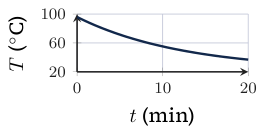
A loaf of bread comes out of an oven at 96\,{}^\circC into a kitchen at 22\,{}^\circC. Its temperature T\,{}^\circC after t minutes is modelled by
\frac{\mathrm{d}T}{\mathrm{d}t}=-0.08\,(T-22),\qquad T=96\text{ when }t=0.
The graph shows how T changes with t according to the model.
Original Photon diagram
(a) Use Euler's method with a step of 5 minutes to estimate the temperature when t=5 and when t=10.
[3]
(b) Show, by separating variables, that T=22+74e^{-0.08t}.
[3]
(c) Find the value of T at t=10 given by the solution in (b), and the percentage error of the estimate in (a).
[3]
(d) Find the time at which the loaf reaches 40\,{}^\circC.
[2]
(e) Explain, using the shape of the graph, why Euler's method underestimates the temperature here.
[1]
Show solutionHide solution
(a) T_1=96+5\times(-0.08)(96-22)=96-29.6=66.4 (M1 A1). T_2=66.4+5\times(-0.08)(66.4-22)=66.4-17.76=48.64 (A1). So about 66.4\,{}^\circC at t=5 and 48.6\,{}^\circC at t=10.
(b) \int\frac{\mathrm{d}T}{T-22}=\int-0.08\,\mathrm{d}t (M1) gives \ln|T-22|=-0.08t+c (A1). At t=0, T-22=74, so T-22=74\mathrm{e}^{-0.08t} and T=22+74\mathrm{e}^{-0.08t} (AG).
(c) T(10)=22+74\mathrm{e}^{-0.8}=55.25 (A1). Percentage error =\frac{48.64-55.25}{55.25}\times100\%=-12.0\% (M1 A1), an underestimate of about 12.0%.
(d) 22+74\mathrm{e}^{-0.08t}=40 gives \mathrm{e}^{-0.08t}=\frac{18}{74} (M1), so t=\frac{\ln(74/18)}{0.08}=17.7 minutes (A1).
(e) The graph is convex (it flattens as it falls), so the tangent line used at the start of each step lies below the curve, and each step ends too low (R1).

Final answer

(a) 66.4, 48.6. (c) 55.3; −12.0%. (d) 17.7 minutes.

Going further

Beyond the syllabus: the worked examples and investigations of the chapter's Going further pages.

Investigation

[13 marks]
Folding paper.
This question asks you to investigate the creases made by folding a strip of paper in half repeatedly.
Ayesha folds a long strip of paper in half, always in the same direction, and then unfolds it. After one fold there is 1 crease. After two folds, unfolded, there are 3 creases. Let c_n be the number of creases after n folds.
(a) Explain why there are 7 creases after three folds.
[2]
(b) Write down the values of c_4 and c_5, and suggest an expression for c_n in terms of n.
[2]
(c) Explain why c_{n+1}=2c_n+1.
[2]
(d) Prove by mathematical induction that your expression in (b) is correct for all n\in\mathbb{Z}^+.
[4]
The paper is 0.1 mm thick. After n folds, before unfolding, the folded strip is 2^n layers thick.
(e) Find the least number of folds for which the folded strip would be more than 1 metre thick.
[2]
(f) Ayesha says that she could fold the strip this many times. Comment on her claim.
[1]
Show solutionHide solution
(a) After two folds the folded strip is 4 layers thick with 3 creases. The third fold puts one new crease across each of the 4 layers, so 3+4=7 creases.
(b) c_4=15 and c_5=31 (that is 7+8 and 15+16). Each is one less than a power of 2, so c_n=2^n-1.
(c) Unfold the first fold last. The unfolded strip is two halves, each carrying the pattern of n folds, so 2c_n creases. The first fold adds one crease between the halves. Hence c_{n+1}=2c_n+1.
(d) For n=1: 2^1-1=1=c_1, so the statement is true. Assume it is true for n=k, that is c_k=2^k-1. Then c_{k+1}=2(2^k-1)+1=2^{k+1}-1. It is true for n=1, and true for n=k implies true for n=k+1, so it is true for all n\in\mathbb{Z}^+ by induction.
(e) In millimetres, 0.1\times2^n>1000 gives 2^n>10000, so n>\log_2 10000=13.3. The least value is n=14, because 2^{13}\times0.1=819.2 mm and 2^{14}\times0.1=1638.4 mm.
(f) The claim is not realistic: each fold doubles the thickness and halves the length, so the strip is too short and too thick to fold long before 14 folds.

Final answer

(a) 3+4=7. (b) c_4=15, c_5=31, c_n=2^n-1. (e) n=14.

Investigation

[12 marks]
Charging a phone.
This question asks you to model how a phone battery charges.
Rahul plugs in his phone and records the charge, P %, every 10 minutes, where t is the time in minutes.
\begin{array}{|c|ccccccc|}\hline t\ (\text{min}) & 0 & 10 & 20 & 30 & 40 & 50 & 60\\\hline P\ (\%) & 20 & 38 & 51 & 63 & 70 & 77 & 82\\\hline\end{array}
(a) Give one reason why a straight-line model of the charge against time must eventually fail.
[1]
Rahul's model is P=100-a\,\mathrm{e}^{-kt}, where a and k are positive constants.
(b) Show that \ln(100-P)=\ln a-kt.
[2]
(c) (i) Using linear regression, find an equation for \ln(100-P) in terms of t.
[2]
(ii) Hence find the values of a and k.
[2]
(d) Use the model to find the time at which the charge reaches 95%.
[2]
Rahul's phone actually reaches 95% after 100 minutes.
(e) Find the percentage error in the prediction from (d).
[2]
(f) Suggest one reason why the model may not describe the charging after 60 minutes.
[1]
Show solutionHide solution
(a) A straight line keeps rising, so it would eventually predict a charge above 100%, which is impossible.
(b) Rearranging, 100-P=a\mathrm{e}^{-kt}. Taking logarithms, \ln(100-P)=\ln a+\ln\mathrm{e}^{-kt}=\ln a-kt.
(c) (i) Regression of \ln(100-P) on t gives \ln(100-P)=4.38-0.0248t (stored values 4.37866 and -0.0248174). (ii) k=0.0248, and a=\mathrm{e}^{4.37866}=79.7.
(d) 95=100-79.73\mathrm{e}^{-0.024817t} gives \mathrm{e}^{-0.024817t}=\frac{5}{79.73}, so t=111.6\approx112 minutes.
(e) Percentage error =\frac{111.58-100}{100}\times100\%=11.6\%.
(f) Phones slow the charging rate near full charge to protect the battery, a change of behaviour that the model does not include.

Final answer

(c) \ln(100-P)=4.38-0.0248t; a=79.7, k=0.0248. (d) 112 minutes. (e) 11.6\%.

From the book

Photon Guidebook: Mathematics HL Paper 3 for the IB Diploma

Chapter 1 teaches how paper 3 works: how the IB builds this kind of Paper 3 question, the techniques, marked worked investigations, and practice investigations like these.

About the book