Investigation 1
[17 marks]This question asks you to investigate the family g_a(x)=\dfrac{x}{x^2+a}, x\in\mathbb{R}, where a is a positive constant.
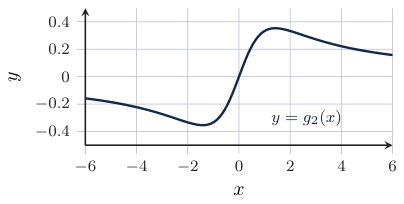
(a) Sketch the graphs of y=g_1(x) and y=g_4(x) on the same axes.
[2]
(b) Show that the graph of y=g_a(x) has stationary points at \left(\pm\sqrt{a},\ \pm\dfrac{1}{2\sqrt{a}}\right).
[4]
(c) Show that every stationary point lies on the curve y=\dfrac{1}{2x}.
[2]
(d) The definition of g_a is extended to negative values of a, with x\ne\pm\sqrt{-a}. Show that for a<0 the graph has no stationary points.
[3]
(e) Given that g_a''(x)=\dfrac{2x(x^2-3a)}{(x^2+a)^3}, state the x-coordinate of each point of inflexion of the graph when a>0.
[3]
(f) Show that the area enclosed by y=g_a(x), the x-axis and the line x=\sqrt{a} does not depend on a, and find its value.
[3]
Show solutionHide solution
(a) Both curves are odd, pass through the origin and tend to 0 as x\to\pm\infty (A1). Maximum points \left(1,\tfrac12\right) on g_1 and \left(2,\tfrac14\right) on g_4, with the minimum points at the mirror images (A1).
(b) Quotient rule: g_a'(x)=\dfrac{(x^2+a)-x\cdot2x}{(x^2+a)^2}=\dfrac{a-x^2}{(x^2+a)^2} (M1 A1). Zero when x^2=a, so x=\pm\sqrt{a} (A1). Then y=\dfrac{\pm\sqrt{a}}{2a}=\pm\dfrac{1}{2\sqrt{a}} (A1).
(c) At a stationary point x^2=a, so y=\dfrac{x}{x^2+x^2} (M1) =\dfrac{1}{2x} (A1).
(d) The same derivative holds for a<0: g_a'(x)=\dfrac{a-x^2}{(x^2+a)^2} (M1). The numerator a-x^2 is negative for every x because a<0 (R1), and the denominator is positive, so g_a'(x)<0 and is never 0 (R1).
(e) g_a''(x)=0 needs 2x(x^2-3a)=0 (M1), so x=0 (A1) or x=\pm\sqrt{3a} (A1).
(f) Area =\displaystyle\int_0^{\sqrt{a}}\dfrac{x}{x^2+a}\,\mathrm{d}x (M1) =\left[\tfrac12\ln(x^2+a)\right]_0^{\sqrt{a}}=\tfrac12\ln(2a)-\tfrac12\ln a (A1) =\tfrac12\ln2, which does not contain a (A1).
Final answer
Humps and dips. (b) g_a'=\frac{a-x^2}{(x^2+a)^2}. (c) x^2=a\Rightarrow y=\frac1{2x}. (d) a-x^2<0. (e) x=0,\pm\sqrt{3a}. (f) \tfrac12\ln2.