Free worked solutions · 2026 Edition

IB Maths HL Paper 3 Chapter 7: Calculus of curves, surfaces and motion worked solutions

Worked solutions to the investigations in Chapter 7 of Photon Guidebook: Mathematics HL Paper 3 for the IB Diploma (2026 Edition). Each solution shows every step with the mark it earns, the way an IB mark scheme does.

  • Chapter 7 of 18
  • 7 practice questions
  • 3 Going further
  • Free, no sign-up

Investigations

The practice investigations of the chapter, each with its full worked solution and mark scheme.

Investigation 1

[16 marks]
This question asks you to design a tin of fixed volume that uses the least material.
A tin is a closed cylinder of radius r cm and height h cm, with a hemispherical lid of radius r in place of a flat top. Its total volume is 500\ \text{cm}^3.
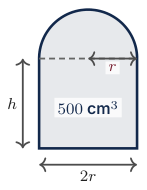
Original Photon diagram
(a) Show that the surface area, including the base and the lid, is S = 2\pi rh + 3\pi r^2.
[2]
(b) Show that S = \dfrac{1000}{r} + \dfrac{5}{3}\pi r^2.
[3]
(c) Find the value of r that minimises S, and justify that it gives a minimum.
[5]
(d) Show that at the minimum h = r.
[3]
(e) Comment on whether this shape would be practical for a food tin.
[3]
Show solutionHide solution
(a) The base has area \pi r^2, the curved side 2\pi rh and the hemispherical lid \frac12\times4\pi r^2=2\pi r^2 (M1). Adding, S=2\pi rh+3\pi r^2 (A1).
(b) The volume is \pi r^2h+\frac23\pi r^3=500 (M1), so h=\dfrac{500-\frac23\pi r^3}{\pi r^2}. Then 2\pi rh=\dfrac{1000}{r}-\frac43\pi r^2 (M1), and S=\dfrac{1000}{r}-\frac43\pi r^2+3\pi r^2=\dfrac{1000}{r}+\frac53\pi r^2 (A1).
(c) \dfrac{dS}{dr}=-\dfrac{1000}{r^2}+\dfrac{10}{3}\pi r (M1)(A1). Setting this to zero, r^3=\dfrac{300}{\pi} (M1), so r=4.57 cm (A1). The second derivative \dfrac{2000}{r^3}+\dfrac{10\pi}3 is positive for every r>0, so the stationary point is a minimum (R1).
(d) At the minimum \pi r^3=300 from (c), so \frac23\pi r^3=200 (M1), so the volume equation gives \pi r^2h=300 (A1). But \pi r^3=300 too, so \pi r^2h=\pi r^3 and h=r (R1).
(e) The least surface area is S=\dfrac{1000}{4.57}+\dfrac53\pi(4.57)^2=328\ \text{cm}^2 (A1). A domed lid does not stack, so the tins waste shelf space (R1), and a curved lid costs more to press than a flat one, which may cancel the small saving in metal (R1).

Final answer

  • A tin with a domed lid. (c) r=\sqrt[3]{300/\pi}=4.57 cm
  • (d) h=r
  • (e) minimum S=328\ \text{cm}^2; any sensible comment on stacking or manufacturing cost.
Investigation 2

[18 marks]
This question asks you to find the area of a region and the volume of the solid formed when it is turned about the x-axis.
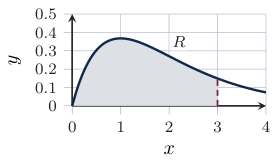
The curve y = xe^{-x} is drawn for x \ge 0. Let R be the region enclosed between this curve, the horizontal axis and the vertical line x=3.
Original Photon diagram
(a) Find the coordinates of the maximum point of the curve.
[4]
(b) Find the exact area of R.
[4]
Turning R once about the x-axis sweeps out a solid of volume V.
(c) Show that V = \pi\left(\dfrac14 - \dfrac{25}{4}e^{-6}\right).
[5]
(d) The line x=3 is replaced by x=a. Find the limit of the volume as a\to\infty.
[2]
(e) Determine a so that the volume is half of this limit.
[3]
Show solutionHide solution
(a) \dfrac{dy}{dx}=e^{-x}-xe^{-x}=(1-x)e^{-x} (M1)(A1). This is zero at x=1 (A1), where y=e^{-1}, so the maximum is at \left(1,\ e^{-1}\right)=(1,\ 0.368) (A1).
(b) By parts with u=x, dv=e^{-x}dx: \displaystyle\int xe^{-x}dx=-xe^{-x}+\int e^{-x}dx (M1), which is -(x+1)e^{-x} (A1). Then \left[-(x+1)e^{-x}\right]_0^3 (M1) =-4e^{-3}+1=1-4e^{-3} (A1), which is 0.801.
(c) V=\pi\displaystyle\int_0^3x^2e^{-2x}dx (M1). By parts, \displaystyle\int x^2e^{-2x}dx=-\tfrac12x^2e^{-2x}+\int xe^{-2x}dx (M1)(A1), and \displaystyle\int xe^{-2x}dx=-\tfrac12xe^{-2x}-\tfrac14e^{-2x}, so the antiderivative is -e^{-2x}\left(\tfrac12x^2+\tfrac12x+\tfrac14\right) (A1). At x=3 this is -e^{-6}\left(\tfrac92+\tfrac32+\tfrac14\right)=-\tfrac{25}4e^{-6} and at x=0 it is -\tfrac14, so V=\pi\left(\tfrac14-\tfrac{25}{4}e^{-6}\right) (A1).
(d) Replacing 3 by a, the value of the antiderivative at a is -e^{-2a}\left(\tfrac12a^2+\tfrac12a+\tfrac14\right) (M1), which tends to 0 as a\to\infty because the exponential beats any polynomial. So V\to\dfrac\pi4=0.785 (A1).
(e) We need \pi\left[\tfrac14-e^{-2a}\left(\tfrac12a^2+\tfrac12a+\tfrac14\right)\right]=\dfrac\pi8 (M1). This simplifies to e^{-2a}\left(2a^2+2a+1\right)=\dfrac12 (A1). A GDC solution gives a=1.34 (A1).

Final answer

  • A glass sculpture. (a) \left(1,\ e^{-1}\right)
  • (b) 1-4e^{-3}=0.801
  • (d) \dfrac\pi4
  • (e) a=1.34.

Investigation 3

[20 marks]
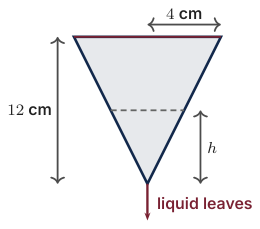
This question asks you to relate the rate at which a funnel empties to the rate at which its depth falls.
A funnel is an inverted cone of height 12 cm and top radius 4 cm. Liquid leaves through the bottom, 2\ \text{cm}^3 every second.
Original Photon diagram
(a) Show that the volume of liquid at depth h cm is V = \dfrac{\pi h^3}{27}.
[3]
(b) Find the rate at which the depth falls when h = 6.
[3]
(c) Find the time taken for a full funnel to empty.
[2]
(d) In fact the outflow rate is k\sqrt{h}. Show that \dfrac{dh}{dt} = -\dfrac{9k}{\pi h^{3/2}}.
[3]
(e) Given that a full funnel empties in 40 s, find k.
[5]
(f) Compare the times for the funnel to drain from full to half depth and from half depth to empty.
[4]
Show solutionHide solution
(a) Similar triangles give \dfrac rh=\dfrac4{12}, so r=\dfrac h3 (M1). The volume of a cone is \frac13\pi r^2h (M1), so V=\frac13\pi\left(\frac h3\right)^2h=\dfrac{\pi h^3}{27} (A1).
(b) \dfrac{dV}{dh}=\dfrac{\pi h^2}{9} (M1). With \dfrac{dV}{dt}=-2 the chain rule gives \dfrac{dh}{dt}=\dfrac{-2}{\pi h^2/9} (A1). At h=6 this is -\dfrac{18}{36\pi}=-0.159\ \text{cm s}^{-1} (A1).
(c) V(12)=\dfrac{\pi\times1728}{27}=64\pi=201\ \text{cm}^3 (M1), so the time is \dfrac{64\pi}2=101 s (A1).
(d) The chain rule gives \dfrac{dV}{dt}=\dfrac{dV}{dh}\dfrac{dh}{dt} with \dfrac{dV}{dt}=-k\sqrt h (M1) and \dfrac{dV}{dh}=\dfrac{\pi h^2}9 (A1). Dividing, \dfrac{dh}{dt}=-\dfrac{9k\sqrt h}{\pi h^2}=-\dfrac{9k}{\pi h^{3/2}} (M1).
(e) Separating, \displaystyle\int h^{3/2}dh=-\dfrac{9k}{\pi}\int dt (M1), so \tfrac25h^{5/2}=-\dfrac{9k}\pi t+c (A1). Between h=12 and h=0 in 40 s: 0-\tfrac25\,12^{5/2}=-\dfrac{9k}{\pi}\times40 (M1), so \tfrac25\,12^{5/2}=\dfrac{360k}{\pi} (A1) and k=\dfrac{2\pi\,12^{5/2}}{5\times360}=1.74 (A1).
(f) The same integral from 12 to h gives the time T(h)=40\left[1-\left(\dfrac h{12}\right)^{5/2}\right] (M1). At h=6 this is 40\left(1-2^{-5/2}\right)=32.9 s (A1), so the lower half of the depth takes 40-32.9=7.07 s (A1). The upper half of the depth holds \dfrac78 of the liquid (87.5%) and takes 82% of the time, because the outflow k\sqrt h is faster when the liquid is deep (R1).

Final answer

  • An emptying funnel. (b) -0.159\ \text{cm s}^{-1}
  • (c) 101 s
  • (e) k=1.74
  • (f) 32.9 s and 7.07 s.

Investigation 4

[22 marks]
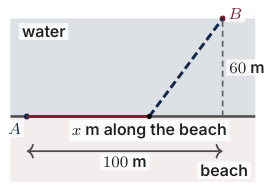
This question asks you to find the quickest route for a lifeguard who runs along a beach and then swims.
A lifeguard at A on a straight beach must reach a swimmer at B, who is 60 m from the beach. The point of the beach nearest to B is 100 m from A. The lifeguard runs along the beach at 6\ \text{m s}^{-1} for x metres, then swims straight to B at 1.5\ \text{m s}^{-1}, where 0\le x\le100.
Original Photon diagram
(a) Show that the total time is T(x) = \dfrac{x}{6} + \dfrac23\sqrt{(100-x)^2+3600}.
[3]
(b) Find T(0) and T(100), and describe the route each represents.
[3]
(c) Find the exact value of x for which T^{\prime}(x)=0.
[5]
(d) Justify that this value of x gives the least time.
[2]
(e) Find the least time exactly, and to three significant figures.
[2]
(f) Find T(80) and comment on how much the choice of x matters near the minimum.
[3]
Now let the running speed be u and the swimming speed w, with w<u, and let \beta be the angle between the swimming path and the perpendicular to the beach.
(g) Show that the quickest route has \sin\beta=\dfrac wu, and find \beta for these speeds.
[4]
Show solutionHide solution
(a) Running takes \dfrac{x}{6} seconds (M1). The swim is the hypotenuse of a triangle with sides 100-x and 60, so its length is \sqrt{(100-x)^2+3600} (M1), and at 1.5 m s^{-1} it takes \dfrac{1}{1.5}\sqrt{\cdots}=\dfrac23\sqrt{\cdots} seconds. Adding gives T(x) (A1).
(b) T(0)=\dfrac23\sqrt{13\,600}=77.7 s (M1): swim the whole way along the straight line to B (A1). T(100)=\dfrac{100}{6}+\dfrac23\times60=56.7 s: run to the nearest point then swim straight out (A1).
(c) With q=100-x, T^{\prime}(x)=\dfrac16-\dfrac23\dfrac{q}{\sqrt{q^2+3600}} (M1)(A1). Setting this to zero gives \dfrac{q}{\sqrt{q^2+3600}}=\dfrac14 (M1). Squaring, 16q^2=q^2+3600, so q^2=240 (M1) and x=100-\sqrt{240}=100-4\sqrt{15}=84.5 (A1).
(d) T^{\prime\prime}(x)=\dfrac{2400}{\left((100-x)^2+3600\right)^{3/2}} (M1), which is positive for every x, so the stationary point is a minimum (R1).
(e) T=\dfrac{100-4\sqrt{15}}6+\dfrac23\sqrt{3840}=\dfrac{50}{3}+10\sqrt{15} (M1), which is 55.4 s (A1).
(f) T(80)=\dfrac{80}6+\dfrac23\sqrt{4000}=55.5 s (M1)(A1). This is 0.1 s above the minimum although x is 4.5 m away from the best value, so the time is very flat near the minimum and a small error in the entry point costs almost nothing (R1).
(g) T(x)=\dfrac xu+\dfrac1w\sqrt{(D-x)^2+p^2} for a beach distance D and a distance p from the beach (M1), so T^{\prime}(x)=\dfrac1u-\dfrac{D-x}{w\sqrt{(D-x)^2+p^2}} (A1). The fraction \dfrac{D-x}{\sqrt{(D-x)^2+p^2}} is the sine of the angle \beta between the swim and the perpendicular to the beach (M1), so T^{\prime}=0 gives \sin\beta=\dfrac wu. Here \sin\beta=\dfrac14 and \beta=14.5^\circ (A1).

Final answer

  • A lifeguard on the beach. (b) 77.7 s and 56.7 s
  • (c) x=100-4\sqrt{15}=84.5 m
  • (e) \dfrac{50}3+10\sqrt{15}=55.4 s
  • (f) 55.5 s
  • (g) \beta=14.5^\circ.

Investigation 5

[22 marks]
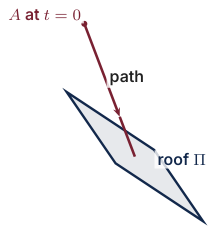
This question asks you to describe the landing path of a drone relative to a sloping roof.
A flat roof is tilted so that it lies in the plane \Pi: x+2y+2z=12, where z is the height in metres above the ground. At time t seconds a drone is at the point \begin{pmatrix}-1\\3\\8\end{pmatrix}+t\begin{pmatrix}1\\0\\-2\end{pmatrix}.
Original Photon diagram
(a) Find the speed of the drone.
[2]
(b) Show that the drone meets the roof, and find the coordinates of the point of contact.
[4]
(c) Find the acute angle between the path of the drone and the roof.
[4]
(d) Show that the perpendicular distance of the drone from the roof at time t is 3-t metres, and find the position of the drone when this distance is 1.5 m.
[4]
(e) An antenna tip is at S(4,1,6). Find the least distance between the drone and S, and the time at which it occurs.
[5]
(f) At the roof the drone rebounds as a perfectly elastic ball would: the component of its direction perpendicular to the roof is reversed. Find its direction after the rebound, and verify that the angle between the new path and the roof equals the angle in (c).
[3]
Show solutionHide solution
(a) Speed is the magnitude of the velocity: \sqrt{1^2+0^2+(-2)^2} (M1) =\sqrt5=2.24\ \text{m s}^{-1} (A1).
(b) Substituting (-1+t,\ 3,\ 8-2t) into the plane equation gives (-1+t)+6+2(8-2t)=12 (M1), which is 21-3t=12 (A1). So t=3 (A1) and the point of contact is (2,\ 3,\ 2) (A1).
(c) The normal is \mathbf n=\begin{pmatrix}1\\2\\2\end{pmatrix} and the direction is \mathbf d=\begin{pmatrix}1\\0\\-2\end{pmatrix}. The angle \varphi between line and plane satisfies \sin\varphi=\dfrac{|\mathbf d\cdot\mathbf n|}{|\mathbf d||\mathbf n|} (M1). Here \mathbf d\cdot\mathbf n=1-4=-3 (A1), so \sin\varphi=\dfrac{3}{3\sqrt5}=\dfrac1{\sqrt5} (A1) and \varphi=26.6^\circ (A1).
(d) The perpendicular distance of a point \mathbf r from the plane is \dfrac{\mathbf n\cdot\mathbf r-12}{|\mathbf n|} (M1). For the drone \mathbf n\cdot\mathbf r=21-3t, so the distance is \dfrac{21-3t-12}3=3-t (A1). The distance is 1.5 when t=1.5 (A1), at the position (0.5,\ 3,\ 5) (A1).
(e) \overrightarrow{DS}=\begin{pmatrix}5-t\\-2\\2t-2\end{pmatrix} (M1), so d^2=(5-t)^2+4+(2t-2)^2=5t^2-18t+33 (A1). The derivative 10t-18=0 (M1) gives t=1.8 s (A1), and d^2=33-5(1.8)^2=16.8, so the least distance is \sqrt{16.8}=4.10 m (A1).
(f) The reflected direction is \mathbf d-\dfrac{2(\mathbf d\cdot\mathbf n)}{|\mathbf n|^2}\mathbf n (M1) =\begin{pmatrix}1\\0\\-2\end{pmatrix}+\dfrac23\begin{pmatrix}1\\2\\2\end{pmatrix}=\dfrac13\begin{pmatrix}5\\4\\-2\end{pmatrix} (A1). For this vector \mathbf d'\cdot\mathbf n=3 and |\mathbf d'|=\sqrt5, so \sin\varphi'=\dfrac3{3\sqrt5}=\dfrac1{\sqrt5}, the same angle 26.6^\circ (A1).

Final answer

  • A drone landing on a roof. (a) \sqrt5=2.24\ \text{m s}^{-1}
  • (b) t=3, (2,3,2)
  • (c) 26.6^\circ
  • (d) (0.5,\ 3,\ 5)
  • (e) 4.10 m at t=1.8 s
  • (f) direction \frac13(5,4,-2).

Investigation 6

[26 marks]
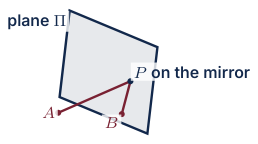
This question asks you to find the shortest path for a light ray that reflects off a plane mirror.
A plane mirror lies in the plane \Pi: 2x + y + 2z = 9. A light source is at A(0, 0, 0) and a sensor at B(1, 4, -1).
Original Photon diagram
(a) Show that A and B lie on the same side of \Pi.
[2]
(b) Find the coordinates of A^{\prime}, the reflection of A in \Pi.
[5]
(c) Explain why, for any point P on \Pi, AP + PB = A^{\prime}P + PB.
[2]
(d) Hence find the length of the shortest path from A to the mirror and then to B.
[3]
(e) Locate the point P on \Pi where the ray reflects, giving its coordinates.
[5]
(f) Verify that AP and PB make equal angles with the normal to \Pi.
[5]
(g) Find the length of the path if the ray instead reflects at the point of \Pi closest to A, and comment.
[4]
Show solutionHide solution
(a) At A: 2(0)+0+2(0)=0<9 (A1). At B: 2+4-2=4<9 (A1). Both are below 9, so both are on the same side.
(b) The normal is \begin{pmatrix}2\\1\\2\end{pmatrix}, so the perpendicular from A is \mathbf r=\lambda\begin{pmatrix}2\\1\\2\end{pmatrix} (M1). It meets \Pi where 2(2\lambda)+\lambda+2(2\lambda)=9 (M1), that is 9\lambda=9, so \lambda=1 (A1) and the foot is F(2,1,2). F is the midpoint of AA^{\prime} (M1), so A^{\prime}=2F-A=(4,\ 2,\ 4) (A1).
(c) \Pi is the perpendicular bisector plane of AA^{\prime} (R1), so every point P of \Pi is equally far from A and from A^{\prime}: AP=A^{\prime}P (R1).
(d) The triangle inequality gives A^{\prime}P+PB\ge A^{\prime}B, with equality when P lies on the segment A^{\prime}B (R1). \overrightarrow{A^{\prime}B}=\begin{pmatrix}-3\\2\\-5\end{pmatrix} (M1), so the shortest path is \sqrt{9+4+25}=\sqrt{38}=6.16 (A1).
(e) The line A^{\prime}B is \mathbf r=\begin{pmatrix}4\\2\\4\end{pmatrix}+s\begin{pmatrix}-3\\2\\-5\end{pmatrix} (M1). Substituting into the plane, 2(4-3s)+(2+2s)+2(4-5s)=9 (M1), which is 18-14s=9 (A1), so s=\dfrac9{14} (A1). Then P=\left(\dfrac{29}{14},\ \dfrac{23}7,\ \dfrac{11}{14}\right) (A1).
(f) \overrightarrow{PA}=\dfrac1{14}\begin{pmatrix}-29\\-46\\-11\end{pmatrix} and \overrightarrow{PB}=\dfrac1{14}\begin{pmatrix}-15\\10\\-25\end{pmatrix} (M1). The angle \varphi with the normal satisfies \cos\varphi=\dfrac{|\mathbf v\cdot\mathbf n|}{|\mathbf v||\mathbf n|} (M1). For PA: \dfrac{126}{3\sqrt{3078}}=0.757 (A1). For PB: \dfrac{70}{3\sqrt{950}}=0.757 (A1). Equal cosines give equal angles, 40.8^\circ, so the law of reflection holds (R1).
(g) The point of \Pi closest to A is the foot F(2,1,2) (M1). AF=\sqrt{4+1+4}=3 (A1) and FB=\left|\begin{pmatrix}-1\\3\\-3\end{pmatrix}\right|=\sqrt{19} (A1), so the path is 3+\sqrt{19}=7.36, which is longer than 6.16. Reflecting at the nearest point to the source ignores where the sensor is, so it is not the shortest path (R1).

Final answer

  • A mirror in space. (b) A^{\prime}=(4,2,4)
  • (d) \sqrt{38}=6.16
  • (e) P=\left(\frac{29}{14},\ \frac{23}7,\ \frac{11}{14}\right)
  • (f) both \cos\varphi=0.757, \varphi=40.8^\circ
  • (g) 3+\sqrt{19}=7.36>6.16.

Investigation 7

[28 marks]
This question asks you to relate the volume of a bowl to the depth of water in it, and to compare bowls of different shapes.
A bowl is formed by rotating the curve y=\dfrac{x^4}{16}, 0\le x\le4, through 2\pi about the y-axis. Lengths are in centimetres, and the water has depth h cm.
Original Photon diagram
(a) Show that the volume of water in the bowl is V=\dfrac{8\pi}3h^{3/2}.
[4]
(b) Find the capacity of the bowl.
[2]
Water is poured in at a constant rate of 40\ \text{cm}^3\,\text{s}^{-1}.
(c) Show that \dfrac{dh}{dt}=\dfrac{10}{\pi\sqrt h}.
[3]
(d) Find the rate at which the depth increases when h=4 and when h=1.
[3]
(e) Find the time taken to fill the bowl.
[2]
(f) Find the exact depth at which the bowl is half full.
[3]
(g) Describe what the formula in (c) predicts as h\to0, and say what this tells you about the model.
[3]
Another bowl is formed by rotating x=k\,y^{1/n}, n>0, about the y-axis, and is filled at a constant rate F.
(h) Show that \dfrac{dh}{dt}=\dfrac{F}{\pi k^2h^{2/n}}.
[5]
(i) For which value of n is the rate at which the depth increases inversely proportional to the depth? What happens to the rate as n becomes very large?
[3]
Show solutionHide solution
(a) Rotating about the y-axis, V=\pi\displaystyle\int_0^hx^2\,dy (M1). From y=\dfrac{x^4}{16}, x^2=4\sqrt y (A1). Then V=\pi\displaystyle\int_0^h4y^{1/2}dy=\pi\left[\dfrac83y^{3/2}\right]_0^h (A1) =\dfrac{8\pi}3h^{3/2} (A1).
(b) The bowl is full at y=\dfrac{4^4}{16}=16 (M1), so the capacity is \dfrac{8\pi}{3}\times64=\dfrac{512\pi}3=536\ \text{cm}^3 (A1).
(c) \dfrac{dV}{dh}=4\pi h^{1/2} (M1)(A1). The chain rule \dfrac{dV}{dt}=\dfrac{dV}{dh}\dfrac{dh}{dt} with \dfrac{dV}{dt}=40 gives 40=4\pi\sqrt h\,\dfrac{dh}{dt} (M1), so \dfrac{dh}{dt}=\dfrac{10}{\pi\sqrt h}.
(d) At h=4: \dfrac{10}{2\pi} (M1) =1.59\ \text{cm s}^{-1} (A1). At h=1: \dfrac{10}\pi=3.18\ \text{cm s}^{-1} (A1).
(e) Time =\dfrac{512\pi/3}{40} (M1) =13.4 s (A1).
(f) Half the capacity is \dfrac{256\pi}3, so \dfrac{8\pi}3h^{3/2}=\dfrac{256\pi}3 (M1) and h^{3/2}=32 (A1). Then h=32^{2/3}=2^{10/3}=10.1 cm (A1).
(g) As h\to0, \sqrt h\to0 so \dfrac{dh}{dt}\to\infty (M1)(A1). The water surface has area \pi x^2=4\pi\sqrt h, which shrinks to nothing at the bottom point, so the model predicts an infinitely fast start; in practice the depth at the first instant is limited by the width of the stream of water and the model cannot be trusted at h=0 (R1).
(h) V=\pi\displaystyle\int_0^hk^2y^{2/n}dy (M1) =\pi k^2\dfrac{n}{n+2}h^{(n+2)/n} (A1). Then \dfrac{dV}{dh}=\pi k^2h^{2/n} (A1). The chain rule with \dfrac{dV}{dt}=F (M1) gives \dfrac{dh}{dt}=\dfrac{F}{\pi k^2h^{2/n}} (A1).
(i) The rate is proportional to h^{-2/n}, which is h^{-1} exactly when \dfrac2n=1 (M1), so n=2 (A1), the paraboloid. As n\to\infty, \dfrac2n\to0, the rate tends to the constant \dfrac F{\pi k^2}, which is the rate for a cylinder (R1).

Final answer

  • A bowl and its depth. (b) \dfrac{512\pi}3=536\ \text{cm}^3
  • (d) 1.59 and 3.18\ \text{cm s}^{-1}
  • (e) 13.4 s
  • (f) h=2^{10/3}=10.1 cm
  • (i) n=2; a constant rate (a cylinder).

Going further

Beyond the syllabus: the worked examples and investigations of the chapter's Going further pages.

Investigation

[23 marks]
Worked investigation 1: Carrying a pipe round a corner.
This question asks you to find the longest pipe that can be carried horizontally round a corner between two corridors.
A corridor of width a metres meets a corridor of width b metres at right angles. A straight pipe is carried horizontally round the corner, touching the inner corner and both outer walls, and makes an angle \theta with the outer wall of the corridor of width a, where 0 < \theta < \dfrac{\pi}{2}.
(a) Show that the length of the pipe in this position is L(\theta) = \dfrac{a}{\sin\theta} + \dfrac{b}{\cos\theta}.
[3]
(b) Find L^{\prime}(\theta).
[2]
(c) Show that L has its least value when \tan\theta = \left(\dfrac{a}{b}\right)^{1/3}, and justify that it is a minimum.
[4]
(d) Show that the least value is \left(a^{2/3} + b^{2/3}\right)^{3/2}.
[4]
(e) Explain why this least value is the length of the longest pipe that can be carried round the corner.
[2]
(f) For a = 2\sqrt{2} and b = 1, find the exact length of the longest pipe, and the angle \theta at which the pipe is tightest.
[3]
(g) The corridors are 2.4 m high. Estimate the longest pipe that could pass the corner if it is tilted, and state one assumption you have made.
[3]
(h) Use your GDC to check your answer to (f) by graphing L(\theta).
[2]
Show solutionHide solution
(a) The part of the pipe in the corridor of width a is the hypotenuse of a right-angled triangle with opposite side a, so its length is \ell_1=\dfrac{a}{\sin\theta} (M1); In the corridor of width b the hypotenuse \ell_2 has b adjacent to \theta, so \ell_2=\dfrac{b}{\cos\theta} (M1); The two parts lie on one straight line through the inner corner, so L=\ell_1+\ell_2 (A1); L(\theta)=\dfrac{a}{\sin\theta}+\dfrac{b}{\cos\theta} (AG).
(b) L=a(\sin\theta)^{-1}+b(\cos\theta)^{-1}, so \dfrac{d}{d\theta}\left[a(\sin\theta)^{-1}\right]=-a\cos\theta(\sin\theta)^{-2} (M1); L^{\prime}(\theta)=-\dfrac{a\cos\theta}{\sin^2\theta}+\dfrac{b\sin\theta}{\cos^2\theta} (A1).
(c) L^{\prime}=0: \dfrac{b\sin\theta}{\cos^2\theta}=\dfrac{a\cos\theta}{\sin^2\theta} (M1); b\sin^3\theta=a\cos^3\theta (A1); \tan^3\theta=\dfrac ab, so \tan\theta=\left(\dfrac ab\right)^{1/3} (AG); L^{\prime}(\theta)=\dfrac{b\sin^3\theta-a\cos^3\theta}{\sin^2\theta\cos^2\theta}; the denominator is positive on 0<\theta<\dfrac\pi2 (M1); The numerator is negative for \tan\theta below \left(\dfrac ab\right)^{1/3} and positive above it, so L^{\prime} changes from negative to positive: a minimum (R1).
(d) Let t=\left(\dfrac ab\right)^{1/3}. A triangle with sides t and 1 has hypotenuse \sqrt{1+t^2}, so \sin\theta=\dfrac{t}{\sqrt{1+t^2}} and \cos\theta=\dfrac{1}{\sqrt{1+t^2}} (M1); L=\sqrt{1+t^2}\left(\dfrac at+b\right) (A1); a=bt^3, so \dfrac at=bt^2 and L=b\sqrt{1+t^2}\,(1+t^2)=b\,(1+t^2)^{3/2} (M1); 1+t^2=1+\dfrac{a^{2/3}}{b^{2/3}}=\dfrac{a^{2/3}+b^{2/3}}{b^{2/3}} (A1); L=b\cdot\dfrac{\left(a^{2/3}+b^{2/3}\right)^{3/2}}{b}=\left(a^{2/3}+b^{2/3}\right)^{3/2} (AG).
(e) A pipe of length \ell can be at angle \theta only if \ell\le L(\theta), because a longer pipe would not touch both outer walls (R1); To get round the corner the pipe passes through every angle from 0 to \dfrac\pi2, so \ell\le L(\theta) for all \theta, which means \ell\le the least value of L (R1).
(f) a^{2/3}=\left(2\sqrt2\right)^{2/3}=\left(2^{3/2}\right)^{2/3}=2 and b^{2/3}=1 (M1); Longest pipe =(2+1)^{3/2}=3\sqrt3\ \text{m}\ (=5.20\ \text{m}) (A1); \tan\theta=\left(2\sqrt2\right)^{1/3}=\sqrt2, so \theta=\arctan\sqrt2=54.7^\circ (A1).
(g) If the pipe rises by at most 2.4 m over its length, its horizontal projection has length \sqrt{\ell^2-2.4^2}, and this projection must pass the corner, so it is at most 3\sqrt3 (M1); \ell\le\sqrt{27+2.4^2}=5.72 m (A1); Assumption: the pipe is straight and thin, and it can rise by the full 2.4 m between its ends while the corridor is wide enough for the tilt (R1).
(h) Graph y=\dfrac{2\sqrt2}{\sin x}+\dfrac1{\cos x} in radians for 0.3\le x\le1.3 and find the minimum (M1); Minimum point (0.955,\ 5.20): 0.955 rad =54.7^\circ and 5.20=3\sqrt3, which agrees with (f) (A1).

Final answer

  • (f) 3\sqrt3 m, at \theta=\arctan\sqrt2=54.7^\circ
  • (g) 5.72 m

Investigation

[26 marks]
Worked investigation 2: Filling a vase.
This question asks you to find the volume of a vase and how fast the water level rises as it is filled.
The inside of a vase is formed by rotating the curve x = 3 + \cos\dfrac{y}{4}, 0 \le y \le 8\pi, through 2\pi about the y-axis. Lengths are in centimetres.
(a) Sketch the profile of the vase, labelling its widest and narrowest radii.
[2]
(b) Show that the volume of water when the depth is h cm is V(h) = \pi\left(9.5h + 24\sin\dfrac{h}{4} + \sin\dfrac{h}{2}\right).
[5]
(c) Find the exact capacity of the vase.
[2]
Water is poured in at a constant rate of 20\ \text{cm}^3\,\text{s}^{-1}.
(d) Show that \dfrac{dh}{dt} = \dfrac{20}{\pi\left(3 + \cos\frac{h}{4}\right)^2}.
[3]
(e) Find the rate at which the depth increases when h = 4\pi, and state the depth at which the level rises fastest.
[3]
(f) Without further integration, explain why the vase is half full when h = 4\pi.
[3]
(g) Find the time taken to fill the vase.
[2]
(h) Sketch the graph of h against t while the vase fills, describing its concavity.
[3]
(i) A designer wants a vase of the same height with profile x = a + \cos\dfrac{y}{4} that holds exactly 1 litre. Find a.
[3]
Show solutionHide solution
(a) The profile has radius 4 at y=0 and at y=8\pi: the widest points, where \cos\dfrac y4=1 (A1); It narrows smoothly to radius 2 at y=4\pi, where \cos\pi=-1, and widens again: a neck half way up (A1).
(b) Discs of radius x and thickness dy give V=\pi\displaystyle\int_0^h x^2\,dy (M1); V=\pi\displaystyle\int_0^h\left(3+\cos\dfrac y4\right)^2dy (A1); \left(3+\cos\dfrac y4\right)^2=9+6\cos\dfrac y4+\cos^2\dfrac y4 (M1); \cos^2\dfrac y4=\dfrac12\left(1+\cos\dfrac y2\right), so the integrand is 9.5+6\cos\dfrac y4+\dfrac12\cos\dfrac y2 (A1); V=\pi\left[9.5y+24\sin\dfrac y4+\sin\dfrac y2\right]_0^h (A1); V(h)=\pi\left(9.5h+24\sin\dfrac h4+\sin\dfrac h2\right) (AG).
(c) Capacity =V(8\pi)=\pi\left(76\pi+24\sin2\pi+\sin4\pi\right) (M1); =76\pi^2\ \text{cm}^3\ (\approx750\ \text{cm}^3) (A1).
(d) Chain rule: \dfrac{dV}{dt}=\dfrac{dV}{dh}\times\dfrac{dh}{dt} with \dfrac{dV}{dt}=20 (M1); \dfrac{dV}{dh}=\pi\left(9.5+6\cos\dfrac h4+\dfrac12\cos\dfrac h2\right) (M1); =\pi\left(3+\cos\dfrac h4\right)^2, so 20=\pi\left(3+\cos\dfrac h4\right)^2\dfrac{dh}{dt} (A1); \dfrac{dh}{dt}=\dfrac{20}{\pi\left(3+\cos\frac h4\right)^2} (AG).
(e) At h=4\pi: \cos\pi=-1, so \dfrac{dh}{dt}=\dfrac{20}{\pi\times2^2} (M1); =\dfrac5\pi=1.59\ \text{cm s}^{-1} (A1); The rate is greatest when the denominator is least, that is when \cos\dfrac h4=-1: at h=4\pi, the narrowest part of the vase (R1).
(f) The profile is symmetric about y=4\pi, because \cos\dfrac{8\pi-y}{4}=\cos\left(2\pi-\dfrac y4\right)=\cos\dfrac y4 (R1); So the disc at height 4\pi-s has the same radius as the disc at 4\pi+s, and the volume below 4\pi equals the volume above it (M1); Hence V(4\pi)=\dfrac12V(8\pi): the vase is half full at h=4\pi (R1).
(g) Time =\dfrac{76\pi^2}{20} (M1); =3.8\pi^2=37.5 seconds (A1).
(h) The graph is an S-shaped curve from (0,0) to (37.5,\ 8\pi), rising throughout (A1); The gradient is greatest at h=4\pi, so the graph has an inflexion at t=\dfrac{38\pi^2}{20}=18.8, h=4\pi (A1); The graph is concave up for t<18.8 (the gradient is increasing as the vase narrows) and concave down after, as the vase widens again (R1).
(i) V=\pi\displaystyle\int_0^{8\pi}\left(a+\cos\dfrac y4\right)^2dy=\pi\left(8\pi a^2+4\pi\right)=8\pi^2\left(a^2+\dfrac12\right) (M1); 8\pi^2\left(a^2+\dfrac12\right)=1000 (A1); a^2=\dfrac{1000}{8\pi^2}-\dfrac12, so a=3.49 (taking a>0) (A1).

Final answer

  • (c) 76\pi^2\ \text{cm}^3
  • (e) \dfrac5\pi=1.59\ \text{cm s}^{-1}, level rises fastest at h=4\pi
  • (g) 37.5 s
  • (i) a=3.49

Investigation

[26 marks]
Worked investigation 3: Two delivery drones.
This question asks you to decide how close two drones flying in straight lines come to each other.
Relative to a base, drone A has position \begin{pmatrix} 2 \\ 0 \\ 5 \end{pmatrix} + t\begin{pmatrix} 3 \\ 4 \\ 1 \end{pmatrix} and drone B has position \begin{pmatrix} 14 \\ 2 \\ 3 \end{pmatrix} + t\begin{pmatrix} -1 \\ 3 \\ 2 \end{pmatrix}, where t is the time in seconds and distances are in metres.
(a) Find the speed of each drone.
[2]
(b) Show that the square of the distance between the drones at time t is 18t^2 - 104t + 152.
[3]
(c) Find the least distance between the drones and the time at which it occurs.
[4]
(d) The drones must stay at least 2 m apart. Find the length of time for which this rule is broken.
[4]
(e) Find the shortest distance between the two flight paths.
[5]
(f) Explain why your answer to (e) is less than your answer to (c).
[2]
(g) Find the acute angle between the flight paths.
[3]
(h) Find the times at which the drones pass the two points where their paths are closest to each other, and use them to support your answer to (f).
[3]
Show solutionHide solution
(a) Speed =\left|\begin{pmatrix}3\\4\\1\end{pmatrix}\right|=\sqrt{9+16+1}=\sqrt{26} for A (M1); Drone B: \sqrt{1+9+4}=\sqrt{14}. Speeds 5.10 and 3.74\ \text{m s}^{-1} (A1).
(b) \overrightarrow{AB}=\begin{pmatrix}14-t-(2+3t)\\2+3t-4t\\3+2t-(5+t)\end{pmatrix}=\begin{pmatrix}12-4t\\2-t\\t-2\end{pmatrix} (M1); d^2=(12-4t)^2+(2-t)^2+(t-2)^2 (A1); =144-96t+16t^2+2\left(t^2-4t+4\right)=18t^2-104t+152 (M1); d^2=18t^2-104t+152 (AG).
(c) Minimise d^2: \dfrac{d}{dt}\left(d^2\right)=36t-104=0 (M1); t=\dfrac{104}{36}=\dfrac{26}{9}=2.89 s (A1); d^2=18\left(\dfrac{26}{9}\right)^2-104\times\dfrac{26}{9}+152=\dfrac{1352-2704+1368}{9}=\dfrac{16}9 (M1); Least distance =\dfrac43=1.33 m (A1).
(d) Rule broken when d<2, that is 18t^2-104t+152<4 (M1); 18t^2-104t+148=0 has roots t=\dfrac{104\pm\sqrt{160}}{36}=\dfrac{26\pm\sqrt{10}}9 (A1); The rule is broken between t=2.54 and t=3.24 (M1); Time =\dfrac{2\sqrt{10}}{9}=0.703 s (A1).
(e) Direction of each path: \mathbf u=\begin{pmatrix}3\\4\\1\end{pmatrix} and \mathbf v=\begin{pmatrix}-1\\3\\2\end{pmatrix}. A vector perpendicular to both: \mathbf n=\mathbf u\times\mathbf v (M1); \mathbf n=\begin{pmatrix}4\times2-1\times3\\1\times(-1)-3\times2\\3\times3-4\times(-1)\end{pmatrix}=\begin{pmatrix}5\\-7\\13\end{pmatrix} (A1); A vector joining a point on each path: \begin{pmatrix}14\\2\\3\end{pmatrix}-\begin{pmatrix}2\\0\\5\end{pmatrix}=\begin{pmatrix}12\\2\\-2\end{pmatrix} (M1); Distance =\dfrac{\left|\begin{pmatrix}12\\2\\-2\end{pmatrix}\cdot\mathbf n\right|}{|\mathbf n|}=\dfrac{|60-14-26|}{\sqrt{243}} (M1); =\dfrac{20}{9\sqrt3}=1.28 m (A1).
(f) The paths include every point each drone ever visits, but part (c) compares the drones only at the same moment (R1); The minimum over all pairs of points is at most the minimum over pairs at equal times, so 1.28\le\dfrac43 (R1).
(g) \mathbf u\cdot\mathbf v=-3+12+2=11 (M1); \cos\theta=\dfrac{11}{\sqrt{26}\sqrt{14}}=\dfrac{11}{\sqrt{364}} (A1); \theta=54.8^\circ (A1).
(h) Let the closest points be A(s) and B(r). Then \overrightarrow{A(s)B(r)} is perpendicular to both directions: 26s-11r=42 and 11s-14r=-10 (M1); s=\dfrac{698}{243}=2.87 s and r=\dfrac{722}{243}=2.97 s (A1); The drones reach their closest points about 0.1 s apart, so they are never at those points together, which supports (f) (R1).

Final answer

  • (c) \dfrac43 m at t=\dfrac{26}9=2.89 s
  • (d) 0.703 s
  • (e) \dfrac{20}{9\sqrt3}=1.28 m
  • (g) 54.8^\circ

From the book

Photon Guidebook: Mathematics HL Paper 3 for the IB Diploma

Chapter 7 teaches calculus of curves, surfaces and motion: how the IB builds this kind of Paper 3 question, the techniques, marked worked investigations, and practice investigations like these.

About the book