Investigation 1
[16 marks]This question asks you to find the averages of a continuous random variable.
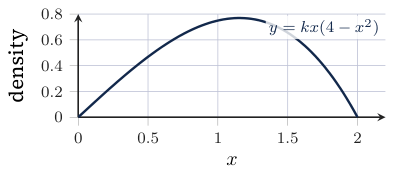
The time, in hours, that a battery in a test rig lasts beyond its warranty is modelled by a continuous random variable X whose density is kx(4 - x^2) on the interval 0 \le x \le 2 and zero elsewhere.
(a) Find the value of the constant k.
[2]
(b) Find the mode of X.
[3]
(c) Find \mathrm{E}(X) and \mathrm{Var}(X).
[5]
(d) Show that the median m satisfies m^4 - 8m^2 + 8 = 0, and hence find the exact value of m.
[4]
(e) Use your answers to describe the skewness of the distribution.
[2]
Show solutionHide solution
(a) The total area is 1: \displaystyle\int_0^2kx(4-x^2)\,\mathrm{d}x=k\left[2x^2-\tfrac{x^4}4\right]_0^2=4k (M1), so k=\tfrac14 (A1).
(b) The mode is where the density is greatest. f(x)=\tfrac14(4x-x^3) and f'(x)=\tfrac14(4-3x^2) (M1), which is zero at x=\tfrac2{\sqrt3} (A1). The sign of f' changes from positive to negative there, so it is a maximum, 1.15 (R1).
(c) \mathrm{E}(X)=\tfrac14\displaystyle\int_0^2(4x^2-x^4)\,\mathrm{d}x (M1) =\tfrac14\left[\tfrac{4x^3}3-\tfrac{x^5}5\right]_0^2=\tfrac14\cdot\tfrac{64}{15}=\tfrac{16}{15} (A1). \mathrm{E}(X^2)=\tfrac14\displaystyle\int_0^2(4x^3-x^5)\,\mathrm{d}x (M1) =\tfrac14\left[x^4-\tfrac{x^6}6\right]_0^2=\tfrac43 (A1). \mathrm{Var}(X)=\tfrac43-\left(\tfrac{16}{15}\right)^2=\tfrac{44}{225}=0.196 (A1).
(d) \displaystyle\int_0^m\tfrac14(4x-x^3)\,\mathrm{d}x=\tfrac14\left(2m^2-\tfrac{m^4}4\right) (M1) =\tfrac12 (A1) gives 2m^2-\tfrac{m^4}4=2, that is m^4-8m^2+8=0 (AG). Then m^2=\dfrac{8\pm\sqrt{32}}2=4\pm2\sqrt2 (M1). Since m<2, m^2=4-2\sqrt2 and m=\sqrt{4-2\sqrt2}=1.08 (A1).
(e) Mean 1.07< median 1.08< mode 1.15 (A1). The tail is on the left, so the distribution is negatively skewed (A1).
Final answer
A curved probability density. (a) k=\tfrac14. (b) \tfrac2{\sqrt3}=1.15. (c) \tfrac{16}{15}=1.07, \tfrac{44}{225}=0.196. (d) m=\sqrt{4-2\sqrt2}=1.08. (e) Mean < median < mode: negatively skewed.