Investigation 1
[16 marks]This question asks you to compare noise levels in a library in an ordinary week and in an exam week.
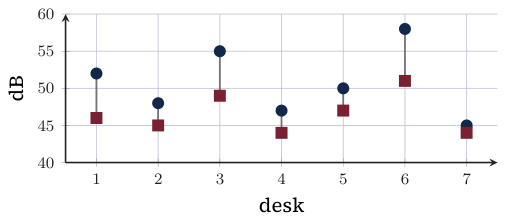
Nadia measures the sound level, in decibels (dB), at seven reading desks in her town library at the same time of day in an ordinary week and again in an exam week.
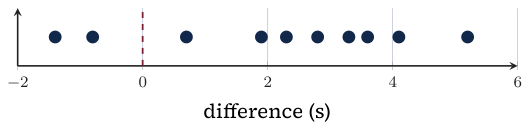
\begin{array}{|l|r|r|r|r|r|r|r|}\hline \text{Desk} & 1 & 2 & 3 & 4 & 5 & 6 & 7\\\hline \text{Ordinary week (dB)} & 52 & 48 & 55 & 47 & 50 & 58 & 45\\\hline \text{Exam week (dB)} & 46 & 45 & 49 & 44 & 47 & 51 & 44\\\hline\end{array}
(a) Name a suitable test to decide whether the mean sound level differs between the two weeks, and give a reason for your choice.
[2]
(b) Find the mean and standard deviation of the differences, ordinary minus exam.
[2]
(c) Carry out the test at the 5% significance level.
[5]
(d) State the assumption your test requires.
[1]
(e) Nadia's friend says the test shows that exam weeks cause the library to be quieter. Comment on this claim.
[2]
(f) Explain why measuring at the same time of day makes Nadia's comparison more valid.
[2]
(g) Suggest one further improvement to Nadia's data collection.
[2]
Show solutionHide solution
(a) paired t-test [R1]; the same seven desks are measured twice, so the two lists are not independent [R1].
(b) differences 6,3,6,3,3,7,1; \bar d=4.14 dB [A1]; s=2.19 dB [A1].
(c) \mathrm{H}_0\colon\mu_d=0, \mathrm{H}_1\colon\mu_d\ne0, where \mu_d is the mean difference in dB for all desks [A1]; paired t-test [M1]; t=5.00, p=0.00246 [A1 A1]; 0.00246<0.05: reject \mathrm{H}_0, the mean sound level differs between the weeks [R1].
(d) the differences are (approximately) normally distributed [R1].
(e) the test shows that the mean level differs, not why [R1]; for example, fewer visitors, or a different mix of users, in exam week [R1].
(f) the noise level varies through the day, so a time difference could produce a difference between weeks [R1]; measuring at the same time removes that source of variation, so the weeks are compared fairly [R1].
(g) for example, choose the desks at random and measure on several days [R1]; so the result does not depend on one day or one corner of the library [R1].
Final answer
- (a) paired t-test, same desks measured twice
- (b) \bar d=4.14 dB, s=2.19 dB
- (c) t=5.00, p=0.00246<0.05, reject \mathrm{H}_0: the mean level differs
- (d) differences normally distributed
- (e) the test shows a difference, not its cause.